


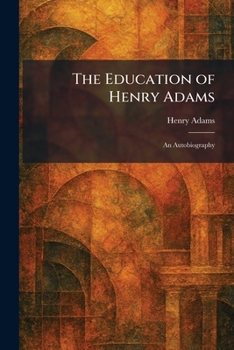
The Education of Henry Adams: An Autobiography

Select Format
Select Condition 
Book Overview
"The Education of Henry Adams" is a seminal work of American literature and intellectual history that redefined the genre of autobiography. Written by Henry Adams, the great-grandson of President John Adams and grandson of President John Quincy Adams, the narrative is presented in the third person, providing a detached and philosophical exploration of a life caught between two eras. The work chronicles Adams's experiences as a journalist, historian, and intellectual during the transformative years of the late 19th and early 20th centuries.
The central theme of the work is the struggle to reconcile a traditional 18th-century education with the chaotic, technological, and industrial reality of the modern age. Adams famously explores the contrast between the spiritual unity of the medieval world and the fragmented multiplicity of the modern world, symbolized by his observations of the dynamo. Awarded the Pulitzer Prize in 1919, "The Education of Henry Adams" serves as both a poignant personal memoir and a profound critique of American society and its political systems. It remains an essential text for understanding the development of the American identity and the challenges of finding meaning within a rapidly accelerating world.
This work has been selected by scholars as being culturally important, and is part of the knowledge base of civilization as we know it. This work was reproduced from the original artifact, and remains as true to the original work as possible. Therefore, you may see the original copyright references, library stamps (as most of these works have been housed in our most important libraries around the world), and other notations in the work.
This work is in the public domain in the United States of America, and possibly other nations. Within the United States, you may freely copy and distribute this work, as no entity (individual or corporate) has a copyright on the body of the work.
As a reproduction of a historical artifact, this work may contain missing or blurred pages, poor pictures, errant marks, etc. Scholars believe, and we concur, that this work is important enough to be preserved, reproduced, and made generally available to the public. We appreciate your support of the preservation process, and thank you for being an important part of keeping this knowledge alive and relevant.
Customer Reviews
ThriftBooks ® and the ThriftBooks ® logo are registered trademarks of Thrift Books Global, LLC
