


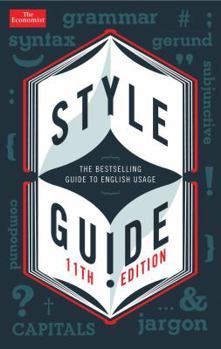
Style Guide (Economist Books)

Select Format
Select Condition 
Book Overview
This expanded eleventh edition of the bestselling guide to style is based on the Economist's own updated house style manual, and is an invaluable companion for everyone who wants to communicate with... This description may be from another edition of this product.
Format:Paperback
Language:English
ISBN:1610395387
ISBN13:9781610395380
Release Date:June 2015
Publisher:The Economist
Length:288 Pages
Weight:0.89 lbs.
Dimensions:8.5" x 0.8" x 5.4"
Customer Reviews
5 ratings
Excellent for non-native speakers
Published by Thriftbooks.com User , 18 years ago
Writing and speaking are the most difficult skills to learn if you're a non-native speaker. Even though most learners believe that speaking is more useful - and there is some vanity involved in it - it's actually writing that takes precedence in today's connected world. Most business communications today are done through email, and no one wants the recipient to have a laugh at their expense. Grammar, punctuation and vocabulary are important, for sure, but once you have mastered those, why not spend a few more hours dedicated to polishing a bit your written English? With just 160 pages, you get tips that will make your writing look formal, but not stilted; correct, but not pretentious. You may even have a laugh or two with the entries.
It doesn't get any better than this.
Published by Thriftbooks.com User , 18 years ago
I speak English as a second language. This style guide has been incredibly useful and informative. I have improved my writing even in other languages thanks to this book. It even is pleasurable reading. In the Guide's own style: Buy it.
Review of brazilian girl
Published by Thriftbooks.com User , 19 years ago
Very useful handbook for writing. It is fashioned similarly to other journalism guides of Brazilian newspapers, but it is far more witty. It brings a section about differences between American and British English - with clues I couldn't find anywhere else. Lots of vocabulary, as usual. It could bring more examples of good and bad practices, though. But I guess those you can find at live on the pages of The Economist itself. Enjoy your reading, Ruli.
Excellent Reference
Published by Thriftbooks.com User , 19 years ago
More than grammar. This book helps with style and it also has reference information on abbreviations, calendars, countries, currencies, science, geology, internet, latin, proofreading, stockmarket, world times, etc. It has many interesting sections.
Style guidance at its best
Published by Thriftbooks.com User , 22 years ago
Simple. Straightforward. Writing instruction as you would expect from perhaps the best magazine on the planet. Clear, concise, to the point. If you want to write well, then buy this book.
Copyright © 2026 Thriftbooks.com Terms of Use
| Privacy Policy | Do Not
Sell/Share My Personal Information | Cookie Policy | Cookie Preferences | Accessibility Statement
ThriftBooks® and the ThriftBooks® logo are registered trademarks of Thrift Books Global, LLC
ThriftBooks® and the ThriftBooks® logo are registered trademarks of Thrift Books Global, LLC
