


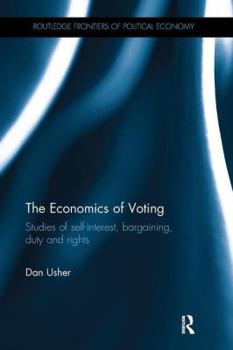
The Economics of Voting: Studies of self-interest, bargaining, duty and rights

Select Format
Select Condition 
Book Overview
The economics of voting is about when, and subject to what qualifications, electoral markets are like ideal commercial markets where universally self-interested behaviour yields outcomes that are in some sense best for society as a whole. Self-interest can be relied upon in voting about the redistribution of income, narrowing the gap between rich and poor, without removing the gap completely, altering people's ordering on the scale of rich and poor or destroying incentives to work and save. Elsewhere, self-interested voting can lead to inconsistent collective behaviour, and must be supported by bargaining, duty and rights.
Bargaining is indispensable in the formation of platforms of political parties, passage of laws in the legislature and other situations where two or more magnitudes must be voted upon simultaneously. Bargaining is ubiquitous but mysterious, with no plausible equilibrium comparable to the equilibrium in competitive markets. A duty to vote arises because the chance of any person's vote influencing the outcome of an election is too small to justify the time and trouble of voting. Wide-spread abstention is corrosive, but the purely self-interested person abstains. A duty to vote need not require a person to vote for the party seen as best for society as a whole. It may be sufficient to vote for the party seen as best for oneself alone.
Rights are the citizen's defence against exploitation. Unconstrained, majority rule voting allows any majority of the electorate that can vote as a block - a majority identified by race, religion or social class - to expropriate the corresponding minority completely. No government in office and its supporters would risk losing office in an election if loss of office meant destitution at the hands of its successors. Constraints include property rights that may be modified by systematic redistribution but not discarded or altered indiscriminately if democratic government is to be preserved.
This book would be of interest to political scientists, economists and philosophers, and would serve as a text for senior undergraduate or graduate courses.
Customer Reviews
ThriftBooks ® and the ThriftBooks ® logo are registered trademarks of Thrift Books Global, LLC
