


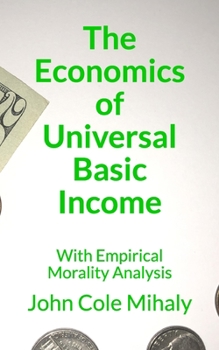
The Economics of Universal Basic Income: With Empirical Morality Analysis
No Customer Reviews

"The Economics of Universal Basic Income: With Empirical Morality Analysis" is a work that explains the idea of universal basic income (UBI) and the arguments surrounding it in the modern day. As a theoretical policy seeking to eliminate poverty and ease the loss of jobs with the onset of automation, UBI attempts to provide a series of dividends to every individual equal to the poverty line. The book explains the contemporary American economic and social context for universal basic income, the definitions of it, and the arguments in favor of it and against it. The work discusses several case studies, the psychology and habits of consumers, and the theoretical and practical economic effects of the implementation of UBI in America. It balances the UBI arguments by a thorough weighing of the data by the author. John Cole Mihaly derives a criteria for analyzing the feasibility and morality of a UBI in the United States from his previous work "The First Treatise Concerning Empirical Morality: Groundwork for Empirical Morality" and discusses his view on its effectiveness. The book concludes with an examination of the political pragmatics of universal basic income as a policy and the likelyhood for its success in the United States.
Format:Paperback
Language:English
ISBN:B086PMNKG3
ISBN13:9798633585667
Release Date:April 2020
Publisher:Independently Published
Length:108 Pages
Weight:0.27 lbs.
Dimensions:0.3" x 5.0" x 8.0"
Customer Reviews
0 rating
Copyright © 2026 Thriftbooks.com
Terms of Use | Privacy Policy | Do Not Sell/Share My Personal Information | Cookie Policy | Cookie Preferences | Accessibility Statement
ThriftBooks ® and the ThriftBooks ® logo are registered trademarks of Thrift Books Global, LLC
ThriftBooks ® and the ThriftBooks ® logo are registered trademarks of Thrift Books Global, LLC
