


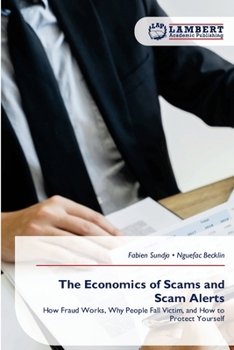
The Economics of Scams and Scam Alerts
No Customer Reviews

In the digital age, scams have evolved into a sophisticated and global phenomenon that affects individuals, businesses, and entire economies. Fraudulent schemes are no longer isolated acts committed by opportunistic criminals; they have developed into organised systems driven by technology, psychology, and financial incentives. The Economics of Scams and Scam Alerts examines this growing challenge through an analytical yet accessible lens, offering readers a deeper understanding of how scams operate, why people fall victim, and how individuals and institutions can protect themselves.The book begins by exploring the economic and behavioural foundations of scams. Fraud is presented not simply as a crime but as a structured activity with identifiable actors, strategies, and incentives. Scammers behave much like entrepreneurs operating in an underground economy. They study markets, identify vulnerable targets, and adapt their methods to exploit new technologies and social trends. By analysing scams through this economic framework, the authors reveal the systematic patterns that allow deception to flourish across different countries and digital platforms.
Format:Paperback
Language:English
ISBN:6209759513
ISBN13:9786209759512
Release Date:March 2026
Publisher:LAP Lambert Academic Publishing
Length:116 Pages
Weight:0.36 lbs.
Dimensions:0.3" x 6.0" x 9.0"
Customer Reviews
0 rating
Copyright © 2026 Thriftbooks.com
Terms of Use | Privacy Policy | Do Not Sell/Share My Personal Information | Cookie Policy | Cookie Preferences | Accessibility Statement
ThriftBooks ® and the ThriftBooks ® logo are registered trademarks of Thrift Books Global, LLC
ThriftBooks ® and the ThriftBooks ® logo are registered trademarks of Thrift Books Global, LLC
