


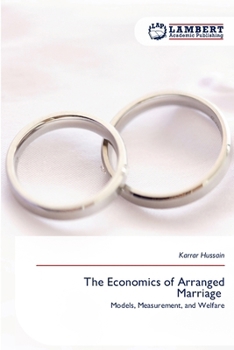
The Economics of Arranged Marriage
No Customer Reviews

This monograph asks why arranged marriage persists across South Asia, the Middle East, and diaspora communities despite a century of modernization, and what determines its success. Drawing on economics, game theory, sociology, and demography, it develops formal models of marriage markets, analyzing information asymmetries, matching, and partner selection, tested against survey data from Pakistan. The first chapter surveys the global literature on theoretical frameworks, empirical evidence, and debates around gender agency, dowry, and marital outcomes. The second chapter builds economic models of arranged marriage markets, distinguishing commitment mechanisms from equilibrium matching. The third synthesizes findings on welfare: when arranged marriages succeed and what shapes their quality and stability. Throughout, the work refuses dichotomies of tradition versus modernity, treating arranged marriage as a complex adaptive institution shaped by strategic interaction, information constraints, and evolving norms. The result is a rigorous and interdisciplinary account of the world's most prevalent yet understudied form of union formation.
Format:Paperback
Language:English
ISBN:6209710808
ISBN13:9786209710803
Release Date:March 2026
Publisher:LAP Lambert Academic Publishing
Length:200 Pages
Weight:0.60 lbs.
Dimensions:0.5" x 6.0" x 9.0"
Customer Reviews
0 rating
Copyright © 2026 Thriftbooks.com
Terms of Use | Privacy Policy | Do Not Sell/Share My Personal Information | Cookie Policy | Cookie Preferences | Accessibility Statement
ThriftBooks ® and the ThriftBooks ® logo are registered trademarks of Thrift Books Global, LLC
ThriftBooks ® and the ThriftBooks ® logo are registered trademarks of Thrift Books Global, LLC
