


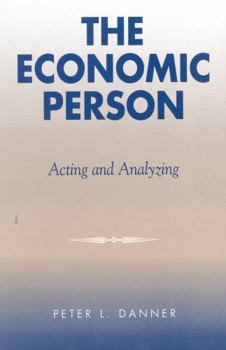
The Economic Person: Acting and Analyzing
No Customer Reviews

Early scholars, perceiving economics as the praxis of persons, emphasized their obligation to share economic goods; to use them prudently and lawfully and to trade or lend them justly. As notional economics grew and became more complex, scholars like Adam Smith perceived economics as a science of human conduct and relations with its own principles of operation. It reflected the secular, amoral, and empirical Zeitgeist of the 19th century, demoting homo economicus into a mere economic agent without moral principles. This book focuses on the human person as a whole self-conscious spirit and a whole material body rather than an economic agent. From this point of view, economic values come under scrutiny. Common practice and ideals are reinterpreted when self-interest melds with "other-interest" to generate economic well-being.
Format:Paperback
Language:English
ISBN:0742513076
ISBN13:9780742513075
Release Date:November 2001
Publisher:Rowman & Littlefield Publishers
Length:192 Pages
Weight:0.64 lbs.
Dimensions:0.6" x 5.9" x 9.0"
Customer Reviews
0 rating
Copyright © 2026 Thriftbooks.com Terms of Use
| Privacy Policy | Do Not
Sell/Share My Personal Information | Cookie Policy | Cookie Preferences | Accessibility Statement
ThriftBooks® and the ThriftBooks® logo are registered trademarks of Thrift Books Global, LLC
ThriftBooks® and the ThriftBooks® logo are registered trademarks of Thrift Books Global, LLC
