


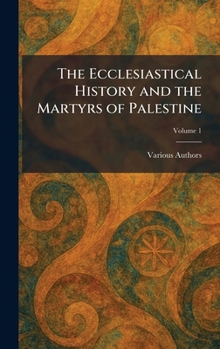
The Ecclesiastical History and the Martyrs of Palestine

"The Ecclesiastical History and the Martyrs of Palestine" is a foundational chronicle detailing the growth and trials of the early Christian Church. This work provides a narrative account of Christianity from its inception through the early fourth century, capturing the evolution of ecclesiastical leadership and the development of core theological traditions. A major focus of the text is the vivid recording of the Diocletianic Persecution, specifically detailing the experiences and ultimate sacrifices of believers in Palestine. By preserving these historical events and primary testimonies, the work offers a unique perspective on the resilience of the early faith against the backdrop of the Roman Empire's shifting political landscape.
As an essential resource for the study of late antiquity, "The Ecclesiastical History and the Martyrs of Palestine" documents the internal struggles of the Church, including its efforts to define orthodoxy in the face of various heresies. This volume serves as a critical historical record, bridging the gap between the biblical era and the institutionalization of the Church. It remains an invaluable text for scholars of religious history, theology, and the cultural history of the Mediterranean world, providing insight into the endurance and expansion of Christianity during its most formative centuries.
This work has been selected by scholars as being culturally important, and is part of the knowledge base of civilization as we know it. This work was reproduced from the original artifact, and remains as true to the original work as possible. Therefore, you may see the original copyright references, library stamps (as most of these works have been housed in our most important libraries around the world), and other notations in the work.
This work is in the public domain in the United States of America, and possibly other nations. Within the United States, you may freely copy and distribute this work, as no entity (individual or corporate) has a copyright on the body of the work.
As a reproduction of a historical artifact, this work may contain missing or blurred pages, poor pictures, errant marks, etc. Scholars believe, and we concur, that this work is important enough to be preserved, reproduced, and made generally available to the public. We appreciate your support of the preservation process, and thank you for being an important part of keeping this knowledge alive and relevant.
Customer Reviews
ThriftBooks ® and the ThriftBooks ® logo are registered trademarks of Thrift Books Global, LLC
