


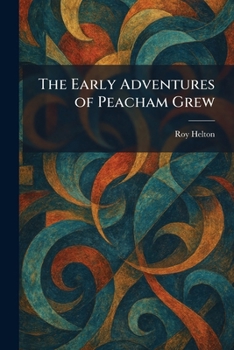
The Early Adventures of Peacham Grew

"The Early Adventures of Peacham Grew" is an enchanting work of fiction by Roy Helton that masterfully explores the intersection of childhood imagination and the physical world. The narrative follows the young protagonist, Peacham Grew, as he navigates a series of experiences that transform the ordinary into the extraordinary. Set with a deep sensitivity to the interior life of a child, the book captures the wonder and complexity of growing up in a world where the boundaries between reality and dreams are often blurred.
Written with the lyrical prose characteristic of Helton's background as a poet, the work is noted for its evocative descriptions and its philosophical depth. Rather than a standard adventure tale, it serves as a profound meditation on how a child's perspective can reshape their surroundings and find magic in the mundane. The story stands as a significant contribution to early 20th-century American literature, particularly for its unique blend of folk-like simplicity and sophisticated storytelling.
Readers interested in coming-of-age themes, literary craftsmanship, and the enduring power of the human spirit will find "The Early Adventures of Peacham Grew" to be a compelling and thought-provoking journey into the heart of youth.
This work has been selected by scholars as being culturally important, and is part of the knowledge base of civilization as we know it. This work was reproduced from the original artifact, and remains as true to the original work as possible. Therefore, you may see the original copyright references, library stamps (as most of these works have been housed in our most important libraries around the world), and other notations in the work.
This work is in the public domain in the United States of America, and possibly other nations. Within the United States, you may freely copy and distribute this work, as no entity (individual or corporate) has a copyright on the body of the work.
As a reproduction of a historical artifact, this work may contain missing or blurred pages, poor pictures, errant marks, etc. Scholars believe, and we concur, that this work is important enough to be preserved, reproduced, and made generally available to the public. We appreciate your support of the preservation process, and thank you for being an important part of keeping this knowledge alive and relevant.
Customer Reviews
ThriftBooks ® and the ThriftBooks ® logo are registered trademarks of Thrift Books Global, LLC
