


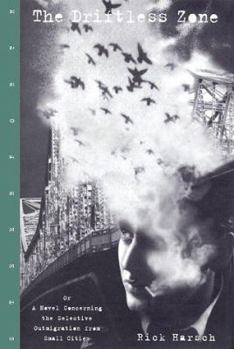
The Driftless Zone: Or, a Novel Concerning the Selective Outmigration from Small Cities
(Book #1 in the The Driftless Trilogy Series)

Select Format
Select Condition 
Book Overview
A demographer visiting La Crosse, Wisconsin, becomes intrigued with the town's residents. This description may be from another edition of this product.
Format:Hardcover
Language:English
ISBN:1883642329
ISBN13:9781883642327
Release Date:January 1
Publisher:Steerforth Press
Length:200 Pages
Weight:0.90 lbs.
Dimensions:1.0" x 5.8" x 8.8"
Customer Reviews
4 ratings
Undiscovered Genius
Published by Thriftbooks.com User , 24 years ago
The previous reviewer is unfortunately wildly mistaken: this first novel of Harsch's Driftless Trilogy is poetic, hilarious, and fiercely intelligent. There are some difficult passages, certainly, but they're well worth it. I am amazed that no one is talking about this writer, and talking loudly, at that. His is one of the most original American voices in years and years. I highly recommend this book!
Great writing and rich with humor.
Published by Thriftbooks.com User , 27 years ago
A dark comedy offering genuinely good writing; a thriller set in LaCrosse, Wisconsin with a host of inventive characters and an exciting literary style. Harsch is a writer to watch.
Tired of unoriginality? You won't find a drop of it here.
Published by Thriftbooks.com User , 27 years ago
In the Driftless Zone, Harsch sets the reader's expectations afloat and then blows them out of the water. Don't sweat it: this is a good thing. In spite of reviewers' tendency to call this book an "homage" to film noir and Raymond Chandler--and it's true there are a lot of film references here--this book is nothing if not original. You can hardly turn a page without finding an array of irreproduceable sentences incandescent with intelligence, and you are even less likely to turn a page without laughing out loud. You will probably want to read passages aloud to your spouse and friends--I know I did. The Driftless Zone is luckily the first book of a trilogy. If you don't look forward to the second and third books (the second, Billy Verite, is already out) after reading this first one, you might want to take your sense of humor and your sense of adventure back to wherever you got them, and try again.
Search for Meaning in a Small Town
Published by Thriftbooks.com User , 28 years ago
Review by Victoria N. Alexander The aptly named Spleen is the alienated hero of Harsch's first novel, THE DRIFTLESS ZONE. While everyone with ambition or talent has happily escaped, Spleen has opted to remain behind in his hometown, a depressed area in Wisconsin called La Crosse. Spleen's lack of motivation may be attributed to his having learned that life has no meaning, but, absurdly, he can't help but pretend that it does. After stalling a good long while, he falls in love and quickly regrets it. His failure is partly due to his own real lack of initiative and partly due to his inability to discover a worthy object. This simple romance plot is made poignant by virtue of its relationship to the novel's larger theme of indeterminacy. Without fixed references, Spleen is reduced to primitive means of searching for significance, to augury for instance, and to reading into appearances. Spleen's world is best described as a post-modern allegory, the meaning of which, while strongly suggestive, is ever illusive. La Crosse is populated with personifications instead of people, characters with names such as "Roman" a Roman seer of sorts, "Darwin" (one of this first characters on the scene who sets the tone for the story as Charles Darwin did for the 20th century), "Fag With No Eyebrows," and Spleen's lover "Sneering Brunette." This could be Bunyan--or Langland. The novel's obsession with determinism would be almost medieval but for its post-modern twist. The determinism is genetic and cultural, not providential. If this situation is sadly comic, it epitomizes the ineffectuality of hope in anytown America. The call for a return to meaningful content throws back a hollow echo. But Harsch is not merely cynical. It is clear that the radical indeterminacy that ails Spleen is tragic BECAUSE of his covert nostalgia for essential meaning behind the sign. Harsch has dubbed the contemporary hero, "Noir Man." The "only reason he believes in anything is because he tells himself he has to or he can't act." Such self-aware practicality makes Spleen a likeable character on the one hand, but, on the other hand, his assumed posture of belief makes him superficially like any of the flat allegorical characters that surround and limit him. And eventually destroy him. Nevertheless, the potential for what was once known as real human heroism is there. It is this that makes the story interesting. In the novel, none of the characters is capable of communicating with any other, but Harsch opens up the inner existences of these stock types TO THE READER, beautifully expressing the Sneering Brunette's pleasure, for example, as that which "lay bruised and hungover, empty from vomiting, dialing a telephone, marvelously spent, attenuated and unafraid." Harsch's insights suggest that while motivation is apparently absent from the world, it seems very real to the individual. As we approach the end of the millennium, writers are looking for the next new direction. Harsch, com
Copyright © 2026 Thriftbooks.com
Terms of Use | Privacy Policy | Do Not Sell/Share My Personal Information | Cookie Policy | Cookie Preferences | Accessibility Statement
ThriftBooks ® and the ThriftBooks ® logo are registered trademarks of Thrift Books Global, LLC
ThriftBooks ® and the ThriftBooks ® logo are registered trademarks of Thrift Books Global, LLC
