


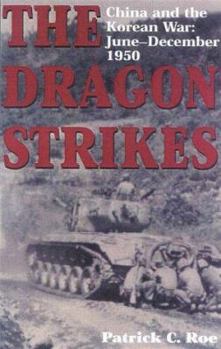
The Dragon Strikes

In June 1950, when Kim Il Sung's Russian-built T-34 tanks rolled southward across the 38th Parallel, the precarious balance of world power was suddenly tilted. Although technically disadvantaged,... This description may be from another edition of this product.
Format:Hardcover
Language:English
ISBN:0891417036
ISBN13:9780891417033
Release Date:June 2000
Publisher:Presidio Press
Length:432 Pages
Weight:1.52 lbs.
Dimensions:8.8" x 1.5" x 6.0"
Customer Reviews
4 ratings
Good English language overview of the Chinese military in Korea
Published by Thriftbooks.com User , 16 years ago
"The Dragon Strikes" is a personal book about the Chinese Army during the first six months of the Korean war from the viewpoint of a former intelligence officer who served with the U.S. Marines during the Chosin reservoir campaign. The book reads easily, although it has been poorly edited and proofed, and may be viewed as an after action report written many years after the event. The notes and bibliography indicate that the sources are all English language and include some of the critical recent secondary works on the Korean War, with the core of the book relying heavily on military intelligence reports written by various levels in the U.S. chain of command. Although the book covers the buildup of the Chinese Army in Korea and the battles between the Chinese and Eighth Army in Northwest Korea, the complex battle between the various Chinese armies and the Eighth Army seems a bit confusing and lacks detail about Chinese troops in the battle. The real strength of the book are the chapters on the clash of X Corps and the Chinese Army in northeast Korea from the end of November through December 1950, particularly the clashes between the Chinese Army and the U.S. Marines. Here the clashes seem much more clearly delineated, and the fate of Chinese units and individual Chinese soldiers seems much more fleshed out. The effects of the cold weather on the poorly-equipped Chinese forces originating in eastern China are revealing. The appendix on the Chinese Communist Army also seems to be a good summary of the quality and sources of the men in the Chinese Army as well as the Army's logistics, general tactics, armaments, and strengths and weaknesses. As someone who has studied Korean history, I was disappointed by the short shrift given to both the North and South Korean militaries, and the occasional use of Japanese place names with no explanation. For example, the author takes note of the lack of heavy armament among the South Korean Divisions that were part of the Eighth Army, but does not note how quickly these divisions must have been thrown together, nor the lack of training and qualified officers in those units. Instead, he notes the Chinese lack of respect for them. Given the significant role played by the South Korean units in the Eighth Army sector, a few more sentences about the South Korean forces would have been appreciated. More significant are the use of the Japanese names, Chosin and Fusen, for the reservoirs in northeast Korea. Although the Koreans, Chinese and Japanese all use the same ideographs for these names, the Korean pronunciations (Changjin and Puchon using the author's romanization system), should at least be clearly indicated at first use in each chapter so that interested readers have some hope of finding the reservoirs in a modern atlas. Overall, I found the book a very interesting and thoughtful account, and especially useful in its coverage of U.S. military intelligence on the Chinese Army during this critical period in th
Marvellous! One of the best books ever written on the Korean War
Published by Thriftbooks.com User , 19 years ago
To anyone who wonders what a new book about the Korean War has to offer, Mr Patrick Roe?s magnificent work gives a most convincing answer. The writer is a military man and he analyzes the reasons and the strategy of the Chinese intervention in Korea in a masterful way, using a wealth of Chinese, Soviet, Korean and American sources. Every bit of detail is here, to satisfy even the most demanding reader: what was the status of the PLA in the eve of the Korean War, what was the military philosophy of Mao and his entourage, how the Soviets repeatedly let down the Chinese offering help and then changing their mind, how the PLA overcame great doubts (and fear) to go for the first time outside their own borders to fight against the most well-equipped force of the era, how the Chinese regarded the nuclear threat of the USA, which forces they employed, how and why, the reasons for choosing General Peng Te Huai to command the Chinese People?s Volunteers, a blow by blow analysis of the battles between the PLA and the UN forces in Korea during the first critical months and, of course, the many mistakes of the US intelligence services who underestimated the Chinese factor for a long time. Highly recommended!
An excellent coverage of a difficult time
Published by Thriftbooks.com User , 25 years ago
I consider this the best book I have read on the first six months of the Korean War. It accurately covers the conflict both before and after the entry of the Chinese. More importantly it gives excellent background on the Chinese, Korean, Soviet relations. It fairly identifies the deficiencies of the high command (Washington and Tokyo) and the problems faced by a badly depleted military force. It coordinates the actions of the Eighth Army and X Corps and identifies the lack there of. With only minor errors it accurately portrays the debacles of late November and early December, a feat rarely done. I know, I was at Koto-ri.
The Dragon and the Horses Mouth
Published by Thriftbooks.com User , 25 years ago
Review of Roe, The Dragon Strikes This is an important book for the serious student of military and political history and for the veterans of the "Forgotten War" - and of other conflicts large and small, before and since. It is a sober, serious carefully organized and closely written work. That should not be read as dull or difficult. It is simply and elegantly composed in terms immediately accessible to any interested reader. I would suggest thatthe reader first scan the final chapter (16), "Looking Back", for a contextual summary of the author1s findings. After that, the Preface tells you who the author is and what motivates him. Itis brief, simple and overly modest. From this point on the chapters develop an account rangingfrom the historical relationships of Asians and Europeans over the last 150 years, to the political aftermath of WW2, the overheated ideological confrontations of "super powers", and the willful - if not entirely intentional, misunderstandings that led up to and resulted in the tragic mishandling of the (multiplex) strategies and tactics of the Korean War. Although it is told in simple language, this is not a simple tale. Roe does not seek or dispense blame. The book is a painstaking and rigorously objective attempt to make sense of the cascade of misconceptions, missteps and faulty decisions that were the pivotal crises of the Korean "Police Action" and the tragedy of that still unresolved war. If the reader discerns incompetence, rampant egotism, chauvinist arrogance or just plain stupidity, these are revealed by the actors themselves, in the context of their actions, and not by the conjecture or "interpretation" of the author. My personal bias should be made clear. Like Pat Roe I am a member of the Chosin Few. As he was a young 2nd Lt. in the 7th Marine Regiment, I was a young Sgt. in the 5th Marines.I came to know him personally a dozen years or so ago. I respect and admire his clear-headed intelligence, his uncompromising - if polite -honesty, his unquestionable personal integrity and his ability to look calmly and objectively at the facts and to organize and present them lucidly, without adjective or adverbial coloring. Roe is known throughout the membership of the Chosin Few for his remark at the first reunion of that fraternity in 1985. On the heels of much in the way of rhetoric and reminiscence and the emotional impact of encountering old comrades and mourning those lost, Roe summarized his viewpoint and his feelings. He wrote simply, "We did a good thing". Pat has done a good and valuable thing in this book. In the Preface he writes that the book is a product of six years of research and writing. This is his only misstatement in 450 pages. The book is the product of fifty years of attention and devotion to duty.
Copyright © 2026 Thriftbooks.com Terms of Use
| Privacy Policy | Do Not
Sell/Share My Personal Information | Cookie Policy | Cookie Preferences | Accessibility Statement
ThriftBooks® and the ThriftBooks® logo are registered trademarks of Thrift Books Global, LLC
ThriftBooks® and the ThriftBooks® logo are registered trademarks of Thrift Books Global, LLC
