


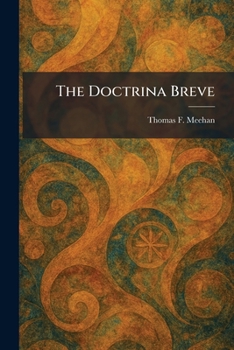
The Doctrina Breve

Select Format
Select Condition 
Book Overview
"The Doctrina Breve" represents a landmark in the religious and typographic history of the Western Hemisphere. Originally authored by Juan de Zum rraga, the first Bishop of Mexico, this work serves as a foundational manual of Christian instruction designed for the spiritual education of the population in the mid-16th century. Written in a clear and structured style, the text outlines the essential tenets of the Catholic faith, including the Creed, the Sacraments, and the Commandments.
Beyond its theological significance, "The Doctrina Breve" holds the prestigious distinction of being the first book printed in the Americas, emerging from the press of Juan Pablos in Mexico City. This volume, with contributions from Thomas F. Meehan, offers an essential window into the early colonial period and the intellectual efforts of the Spanish missions. It provides invaluable insights into the methods of evangelization and the rapid spread of European printing technology across the Atlantic. As a primary historical source, it remains an indispensable resource for scholars of Latin American history, bibliography, and ecclesiastical studies, illustrating the intersection of faith and the written word in the New World.
This work has been selected by scholars as being culturally important, and is part of the knowledge base of civilization as we know it. This work was reproduced from the original artifact, and remains as true to the original work as possible. Therefore, you may see the original copyright references, library stamps (as most of these works have been housed in our most important libraries around the world), and other notations in the work.
This work is in the public domain in the United States of America, and possibly other nations. Within the United States, you may freely copy and distribute this work, as no entity (individual or corporate) has a copyright on the body of the work.
As a reproduction of a historical artifact, this work may contain missing or blurred pages, poor pictures, errant marks, etc. Scholars believe, and we concur, that this work is important enough to be preserved, reproduced, and made generally available to the public. We appreciate your support of the preservation process, and thank you for being an important part of keeping this knowledge alive and relevant.
Customer Reviews
ThriftBooks ® and the ThriftBooks ® logo are registered trademarks of Thrift Books Global, LLC
