


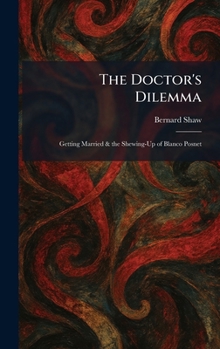
The Doctor's Dilemma: Getting Married & the Shewing-Up of Blanco Posnet

This collection features three provocative plays by the celebrated dramatist Bernard Shaw, showcasing his sharp wit and unwavering commitment to social critique. In "The Doctor's Dilemma", Shaw explores the ethical minefield of the medical profession, centering on a physician who must decide which of two patients to save: a kind-hearted but medically unremarkable individual or a brilliant but unscrupulous artist. This work serves as a scathing satire on the pretensions and inconsistencies of the medical establishment of the early 20th century.
"Getting Married" turns a keen eye toward the institution of matrimony. Eschewing traditional plot structures, the play unfolds as a spirited debate among a diverse group of characters gathered for a wedding, dissecting the legal, religious, and social constraints of marriage with Shaw's characteristic intellectual vigor. Finally, "The Shewing-Up of Blanco Posnet" offers a stark departure as a "sermon in crude melodrama" set in the American Wild West. It follows a horse thief's unexpected spiritual awakening, challenging conventional notions of morality and religion.
Together, these works represent Shaw's mastery of the "play of ideas," using the stage as a forum for examining the complex moral and social fabric of society. This collection remains a vital testament to Shaw's enduring influence on modern literature and drama.
This work has been selected by scholars as being culturally important, and is part of the knowledge base of civilization as we know it. This work was reproduced from the original artifact, and remains as true to the original work as possible. Therefore, you may see the original copyright references, library stamps (as most of these works have been housed in our most important libraries around the world), and other notations in the work.
This work is in the public domain in the United States of America, and possibly other nations. Within the United States, you may freely copy and distribute this work, as no entity (individual or corporate) has a copyright on the body of the work.
As a reproduction of a historical artifact, this work may contain missing or blurred pages, poor pictures, errant marks, etc. Scholars believe, and we concur, that this work is important enough to be preserved, reproduced, and made generally available to the public. We appreciate your support of the preservation process, and thank you for being an important part of keeping this knowledge alive and relevant.
Related Subjects
DramaCustomer Reviews
ThriftBooks ® and the ThriftBooks ® logo are registered trademarks of Thrift Books Global, LLC
