


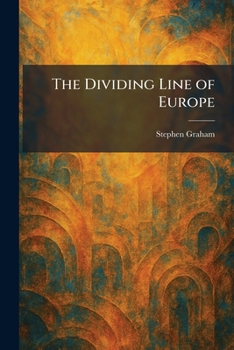
The Dividing Line of Europe

"The Dividing Line of Europe" is a compelling geopolitical and travel narrative that examines the precarious state of Eastern Europe in the wake of the Russian Revolution and the First World War. Written by the renowned traveler and social observer Stephen Graham, the work provides an on-the-ground perspective of the newly independent nations forming a buffer between Western civilization and the burgeoning Soviet Union. Graham journeys through Finland, Estonia, Latvia, Lithuania, Poland, and Romania, documenting the cultural tensions, political uncertainties, and the physical reality of the new frontiers.
With a focus on the concept of the "cordon sanitaire," Graham explores the challenges these border states face as they navigate their identity against the shadow of Bolshevism. The book offers deep insights into the social fabric of 1920s Europe, blending personal observation with historical analysis. Readers will find a vivid account of the shifts in national borders and the human stories behind the changing maps of the early twentieth century. As a significant piece of political travel writing, "The Dividing Line of Europe" remains an essential text for understanding the historical roots of contemporary European geopolitics and the enduring divide between East and West.
This work has been selected by scholars as being culturally important, and is part of the knowledge base of civilization as we know it. This work was reproduced from the original artifact, and remains as true to the original work as possible. Therefore, you may see the original copyright references, library stamps (as most of these works have been housed in our most important libraries around the world), and other notations in the work.
This work is in the public domain in the United States of America, and possibly other nations. Within the United States, you may freely copy and distribute this work, as no entity (individual or corporate) has a copyright on the body of the work.
As a reproduction of a historical artifact, this work may contain missing or blurred pages, poor pictures, errant marks, etc. Scholars believe, and we concur, that this work is important enough to be preserved, reproduced, and made generally available to the public. We appreciate your support of the preservation process, and thank you for being an important part of keeping this knowledge alive and relevant.
Customer Reviews
ThriftBooks ® and the ThriftBooks ® logo are registered trademarks of Thrift Books Global, LLC
