


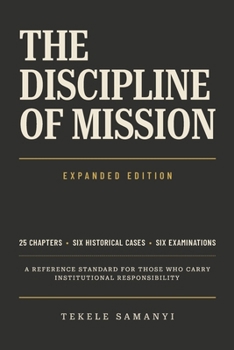
The Discipline of Mission: A Reference Standard for Those Who Carry Institutional Responsibility (Expanded Edition)

Authority is not a reward. It is a debt.
Leadership is often sold as influence, visibility, confidence, vision, and success.
The Discipline of Mission begins somewhere harder.
What happens after the title is granted? What happens when the mission becomes inconvenient, unpopular, isolating, or personally costly? What does authority require when obedience is difficult, information is incomplete, failure has consequences, and loyalty itself must be questioned?
This Expanded Edition treats leadership not as personal advancement, but as institutional responsibility under constraint.
Tekele Samanyi examines the disciplines that separate authority from entitlement, obedience from submission, mission from ambition, accountability from humiliation, and legacy from reputation.
The book asks a demanding question:
If you accept the authority, are you also prepared to accept the account that comes with it?
Through twenty-five chapters, documented historical cases, institutional examinations, practical frameworks, and companion essays, the book explores:
why obedience to legitimate mission must precede authority;how responsibility creates costs that titles rarely disclose;why popularity cannot prove a decision right, and resistance cannot prove it wrong;how power changes the quality of information reaching the leader;when failure becomes instruction, and when calling it learning becomes an excuse;why dissent can sometimes become a duty;when loyalty must end;why succession is part of leadership rather than an event after it;how the private costs of public responsibility can fall on people who never accepted the office themselves;and why the final test of leadership is whether the institution can continue without the leader.The Expanded Edition includes six substantial historical examinations involving Ernest Shackleton and the Imperial Trans-Antarctic Expedition, Katharine Graham and the Pentagon Papers, the Challenger disaster, Apollo 1, Hugh Thompson at Sơn Mỹ, and George C. Marshall, together with a companion essay examining John and Abigail Adams and the private account of public duty.
These cases are not presented as heroic mythology. Each is examined for what the evidence supports, what it does not establish, and what institutional leaders can legitimately learn from it.
The book closes with The Standard, twenty-five compressed principles drawn from the arguments developed throughout the work.
This is not a book about becoming important.
It is about becoming answerable.
Leadership is temporary.
Authority is conditional.
The account remains.
For executives, managers, public officials, institutional leaders, military and professional decision-makers, and anyone entrusted with consequences that extend beyond themselves, The Discipline of Mission offers something more demanding than inspiration: a standard.
Customer Reviews
ThriftBooks ® and the ThriftBooks ® logo are registered trademarks of Thrift Books Global, LLC
