


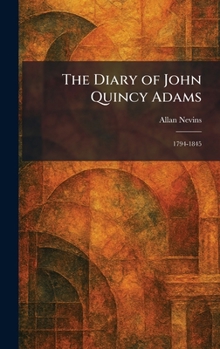
The Diary of John Quincy Adams: 1794-1845

The Diary of John Quincy Adams 1794-1845 offers an unparalleled firsthand account of the formative years of the United States through the eyes of one of its most dedicated and intellectual public servants. Spanning over half a century, this work captures the private reflections and public observations of the sixth President of the United States. Adams's writings follow his extraordinary career as a young diplomat in Europe, a United States Senator, the architect of the Monroe Doctrine as Secretary of State, and his tenure in the White House, concluding with his final years as a fierce advocate in the House of Representatives.
The diary provides deep insights into the political maneuvers of the early Republic, the complexities of international relations during the Napoleonic era, and the escalating domestic tensions over slavery and continental expansion. Edited by the distinguished historian Allan Nevins, this selection distills the most significant entries from the vast original record, showcasing Adams's moral conviction, intellectual rigor, and sharp social commentary. As both a primary historical document and a personal confession, "The Diary of John Quincy Adams 1794-1845" remains an essential resource for understanding the foundations of American policy and the character of a man who witnessed the transition of a collection of colonies into a rising global power.
This work has been selected by scholars as being culturally important, and is part of the knowledge base of civilization as we know it. This work was reproduced from the original artifact, and remains as true to the original work as possible. Therefore, you may see the original copyright references, library stamps (as most of these works have been housed in our most important libraries around the world), and other notations in the work.
This work is in the public domain in the United States of America, and possibly other nations. Within the United States, you may freely copy and distribute this work, as no entity (individual or corporate) has a copyright on the body of the work.
As a reproduction of a historical artifact, this work may contain missing or blurred pages, poor pictures, errant marks, etc. Scholars believe, and we concur, that this work is important enough to be preserved, reproduced, and made generally available to the public. We appreciate your support of the preservation process, and thank you for being an important part of keeping this knowledge alive and relevant.
Customer Reviews
ThriftBooks ® and the ThriftBooks ® logo are registered trademarks of Thrift Books Global, LLC
