


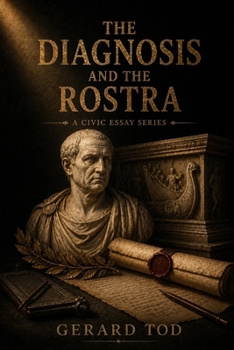
The Diagnosis and the Rostra: A Civic Essay Series
No Customer Reviews

In 63 BC, Cicero stood in the Senate and called Catiline a pestis, a plague loose in the body of the republic. The label did the work an argument would have taken longer to do. Five conspirators were strangled that night without trial. Twenty years later, Cicero used the same technique on Mark Antony, plague, contagion, degenerate, across fourteen speeches. In December of 43 BC, Antony had him killed for it. Cicero's hands, which had written the words, and his head, which had spoken them, were nailed to the Rostra, the platform he had used to speak. In 2023, a sitting American president described immigration as "poisoning the blood of our country" and, separately, called political opponents "vermin." In 2026, a federal policy began requiring Medicaid recipients with terminal illnesses to prove, on paper, that they are too sick to work before they can keep coverage they already qualified for. The vocabulary changes less than it should. In The Diagnosis and the Rostra, Gerard Tod turns to Cicero, the only Roman statesman who wielded this weapon and later died by it, to ask five plain questions: Who is being diagnosed. Who is doing the diagnosing. What disease is named. What cure follows. And what happens once the platform outlives the speaker. This is not a book asking readers to master Latin rhetoric or ancient history. It is asking readers to notice the exact sentence where a description turns into a directive. The platform never asked who it would hold next.
Format:Paperback
Language:English
ISBN:B0HDFZ8X54
ISBN13:9798191351001
Release Date:August 2026
Publisher:Independently Published
Length:42 Pages
Weight:0.15 lbs.
Dimensions:0.1" x 6.0" x 9.0"
Customer Reviews
0 rating
Copyright © 2026 Thriftbooks.com
Terms of Use | Privacy Policy | Do Not Sell/Share My Personal Information | Cookie Notice | Cookie Preferences | Accessibility Statement
ThriftBooks ® and the ThriftBooks ® logo are registered trademarks of Thrift Books Global, LLC
ThriftBooks ® and the ThriftBooks ® logo are registered trademarks of Thrift Books Global, LLC
