


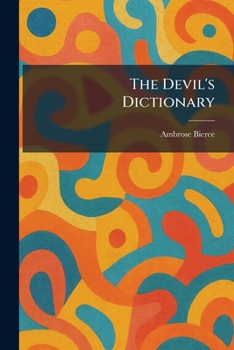
The Devil's Dictionary

"The Devil's Dictionary" is a masterpiece of satirical literature, offering a collection of wickedly witty definitions that lampoon the hypocrisies of politics, religion, and social life. Written by the American journalist and short-story writer Ambrose Bierce, this lexicon of cynicism redefines common words with sharp-tongued humor and profound skepticism. Each entry serves as a brief but potent critique of human nature and established institutions, showcasing Bierce's unparalleled talent for sardonic commentary.
From defining "politics" as a strife of interests masquerading as a contest of principles to "lawyer" as one skilled in circumvention of the law, the book remains as relevant today as when its entries were first penned. This enduring work of dark humor challenges readers to reconsider their own values and the language used to express them. "The Devil's Dictionary" is an essential read for those who appreciate intellectual bite, linguistic precision, and a healthy dose of misanthropy. It stands as a landmark of American letters, capturing a disillusioned spirit while providing timeless entertainment for fans of satire and philosophy alike.
This work has been selected by scholars as being culturally important, and is part of the knowledge base of civilization as we know it. This work was reproduced from the original artifact, and remains as true to the original work as possible. Therefore, you may see the original copyright references, library stamps (as most of these works have been housed in our most important libraries around the world), and other notations in the work.
This work is in the public domain in the United States of America, and possibly other nations. Within the United States, you may freely copy and distribute this work, as no entity (individual or corporate) has a copyright on the body of the work.
As a reproduction of a historical artifact, this work may contain missing or blurred pages, poor pictures, errant marks, etc. Scholars believe, and we concur, that this work is important enough to be preserved, reproduced, and made generally available to the public. We appreciate your support of the preservation process, and thank you for being an important part of keeping this knowledge alive and relevant.
Customer Reviews
ThriftBooks ® and the ThriftBooks ® logo are registered trademarks of Thrift Books Global, LLC
