


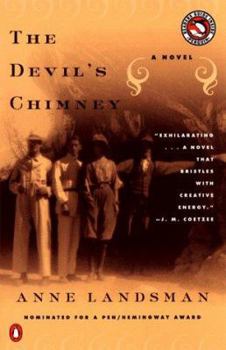
The Devil's Chimney

Select Format
Select Condition 
Book Overview
In Oudtshoorn, South Africa, Connie Lambrecht lives in the shadow of the vast Cango Caves. In the depths of one of the eerie passages they call the Devil's Chimney, a young colored servant girl once... This description may be from another edition of this product.
Format:Paperback
Language:English
ISBN:0140277463
ISBN13:9780140277463
Release Date:January 1999
Publisher:Penguin Books
Length:304 Pages
Weight:0.50 lbs.
Dimensions:7.7" x 0.6" x 5.2"
Customer Reviews
1 rating
WRITTEN WITH FLUID GRACE
Published by Thriftbooks.com User , 25 years ago
A mellifluous rendering of lives stunted by isolation and despair is rare. Yet Anne Landsman deftly accomplishes this in her transfixing debut novel The Devil's Chimney. Set in turn of the century South Africa, Ms. Landsman's narrative shimmers with scenes of windswept agrarian beauty and sizzles with the erotic as she describes passion run amok during the days of apartheid when Coloureds and women were disposable. Poignantly related by Connie, an older woman who has sought release in alcohol, this is the tale of two women from dissimilar backgrounds. Their commonality, as Ms. Landsman skillfully reveals, is found in the loss of an only child. With her feckless and abusive husband, Jack, Connie now oversees a dog kennel not far from Canga Caves, the area's major tourist attraction and home of Devil's Chimney, an aperture so narrow that you have to crawl through it on your stomach. Pregnant and afraid of being sent to Magdalena Tehuis, where they give your baby away and "make the girls wear maids' dresses and scrub the floors," Connie married Jack when she was 18. Two months later their child was stillborn, then buried in the yard beneath a lemon tree. As Connie reflects upon her life, she interweaves the story of Miss Beatrice and Mr. Henry, a well-to-do English couple who came to Oudtshoorn in 1910 to run an ostrich ranch. Although "An ostrich can split you in half with the nail on his big toe," at that time their exquisite feathers - prime whites, tipped whites, spadonas, blacks - brought a high price. During Mr. Henry's mysterious disappearance into the mountains, Miss Beatrice determines to find out all she can about ostrich farms from Mr. Jacobs, the Jewish owner of a neighboring ranch who is successful enough to be known as the Ostrich King. Society's cruel divisions are underscored as she thinks of meeting him: "Was there garlic in his pockets and a black beard covering his whole face?.......Your neighbors aren't Jews. The Boers are bad enough, and so are the Poor Whites but the Jews." As Miss Beatrice learns about the care and raising of the valuable birds, we, too, are privy to a lost skill practiced in a culture rife with superstition and medicinal potions. Herding the graceful birds into pens or kraals to be brutally plucked mirrors the narrowly circumscribed lives of Connie and Miss Beatrice, both bound to the veld by time and circumstance. Eventually, Miss Beatrice and Mr. Jacobs become lovers, lying together in a cave's ebony darkness. She also has a physical relationship with September, her native servant. Thus, when Miss Beatrice discovers she is pregnant she is unsure of the baby's father, and is left to bear the child alone with only Nomsa, September's wife, to assist her. As Connie recreates the final tragedy in Miss Beatrice's life she does, to a degree, come to terms with the adversity she has endured. With scenes as clearly drawn as a stereoscope's slide, Ms. Landsman
Copyright © 2026 Thriftbooks.com Terms of Use
| Privacy Policy | Do Not
Sell/Share My Personal Information | Cookie Policy | Cookie Preferences | Accessibility Statement
ThriftBooks® and the ThriftBooks® logo are registered trademarks of Thrift Books Global, LLC
ThriftBooks® and the ThriftBooks® logo are registered trademarks of Thrift Books Global, LLC
