


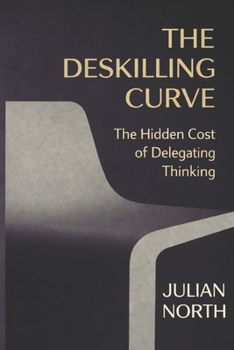
The Deskilling Curve: The Hidden Cost of Delegating Thinking

You do not lose your skills all at once.
You lose them slowly, while everything still works.
The Deskilling Curve examines a subtle but accelerating problem of modern professional life: the gradual erosion of human judgment, intuition, and problem-solving as more thinking is delegated to systems, processes, and tools.
This is not a book about artificial intelligence.
It is a book about what happens to people when thinking becomes optional.
Across organizations, professions, and roles, competence is quietly hollowed out. Decisions are still made, outputs are still produced, and performance often appears stable. Yet beneath the surface, the capacity to reason independently, detect weak signals, and navigate uncertainty is thinning.
Julian North introduces the concept of the deskilling curve to explain how this happens, why it often goes unnoticed, and why its consequences only appear when it is too late to correct easily.
This book explores:
Why efficiency can undermine long-term capabilityHow delegation slowly replaces judgment rather than supporting itWhy experienced professionals are often the most vulnerableHow systems designed to help can quietly weaken thinkingWhat individuals and organizations can do to interrupt the curve before it hardensThe Deskilling Curve does not argue against tools, automation, or progress. It argues for awareness. For deliberate friction. For protecting the kinds of thinking that cannot be outsourced without cost.
This is a book for professionals, leaders, and organizations that still believe competence matters, especially when conditions change.
Customer Reviews
ThriftBooks® and the ThriftBooks® logo are registered trademarks of Thrift Books Global, LLC
