


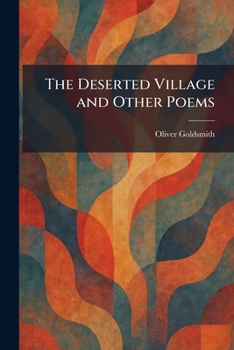
The Deserted Village and Other Poems

Select Format
Select Condition 
Book Overview
"The Deserted Village and Other Poems" showcases the evocative and influential verse of Oliver Goldsmith, one of the 18th century's most celebrated literary figures. The title poem, "The Deserted Village," serves as a poignant social commentary on the decline of rural life and the devastating impact of the enclosure movement on the English countryside. Through vivid imagery and nostalgic sentiment, Goldsmith mourns the loss of a once-vibrant community while critiquing the pursuit of wealth at the expense of human happiness.
This collection also includes "The Traveller," a philosophical and descriptive poem that explores national character and the nature of contentment through the lens of a wanderer across Europe. Goldsmith's mastery of the heroic couplet and his ability to blend personal emotion with broader political and social themes are on full display throughout these pages. From lyrical meditations to sharp observations of human nature, this volume provides a comprehensive look at the poetic genius of a writer who bridged the gap between the Augustan and Romantic eras. A cornerstone of English pastoral poetry, this work remains a powerful testament to the enduring bond between people and their land.
This work has been selected by scholars as being culturally important, and is part of the knowledge base of civilization as we know it. This work was reproduced from the original artifact, and remains as true to the original work as possible. Therefore, you may see the original copyright references, library stamps (as most of these works have been housed in our most important libraries around the world), and other notations in the work.
This work is in the public domain in the United States of America, and possibly other nations. Within the United States, you may freely copy and distribute this work, as no entity (individual or corporate) has a copyright on the body of the work.
As a reproduction of a historical artifact, this work may contain missing or blurred pages, poor pictures, errant marks, etc. Scholars believe, and we concur, that this work is important enough to be preserved, reproduced, and made generally available to the public. We appreciate your support of the preservation process, and thank you for being an important part of keeping this knowledge alive and relevant.
Customer Reviews
ThriftBooks ® and the ThriftBooks ® logo are registered trademarks of Thrift Books Global, LLC
