


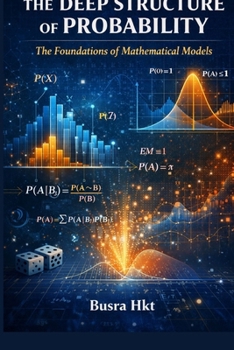
The Deep Structure of Probability: The Foundations of Mathematical Models

Probability is not merely a collection of formulas - it is a deep mathematical structure underlying statistics, data science, stochastic modeling, finance, machine learning, and theoretical research. This work presents a systematic and axiomatic foundation of probability measures, distribution theory, multidimensional structures, convergence concepts, limit theorems, and statistical connections.
From measure-theoretic probability to concentration inequalities, from characteristic functions to infinite divisibility, from stochastic dominance to parametric statistical models - the mathematical architecture of uncertainty is developed with precision and structural clarity.
This book builds a bridge between pure probability theory and modern statistical modeling, offering a coherent framework for understanding convergence, dependence structures, filtration, conditional expectation, and asymptotic analysis.
Questions Answered in This Book
What is the deep structure behind probability measures?
How do discrete and continuous distributions relate under absolute continuity?
What is the geometric meaning of covariance and correlation?
How do characteristic functions determine distributions?
Why are limit theorems fundamental to statistical inference?
How do concentration inequalities control random fluctuations?
What are the precise differences between types of convergence?
How does probability theory connect to parametric statistical models?
What role does identifiability play in inference?
How do likelihood principles and information criteria emerge from probability foundations?
Who Should Read This Book?
Graduate students in mathematics, statistics, and data science
Researchers working in probability theory and stochastic processes
Machine learning specialists seeking deeper theoretical foundations
Financial engineers and quantitative analysts
Academics preparing advanced probability courses
Statisticians interested in asymptotic theory
Professionals working with uncertainty modeling
Readers aiming for rigorous measure-theoretic understanding
Customer Reviews
ThriftBooks ® and the ThriftBooks ® logo are registered trademarks of Thrift Books Global, LLC
