


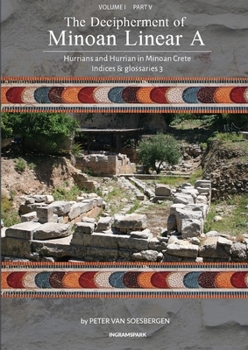
The Decipherment of Minoan Linear A, Volume I, Part V: Hurrians and Hurrian in Minoan Crete: Indices and glossaries 3
No Customer Reviews

One feature of Minoan-Hurrian appears to corresponds specifically with the evidence from Nippur, where Hurrian personal names are attested with the theophorous element irmi / ermi as a variant of erwi at Nuzi and ewri / ibri 'Lord' and 'king' in the Tusratta letter and elsewhere, cf. Ir-me/mi-ta-at-ta and Ir-me-ta-ta at Nippur (Clay PNCP, 93), to be read Erme/i-tatta, i.e. *Erwi-tatta, according to P.M. Purves (NPN, 263). But Linear A erwi also occurs. Several personal names with the element e-mi / i-mi are attested in Linear A. They can be identified with ermi / irmi, since according to Linear A and B orthographic conventions -r- preceding -m- is not expressed in consonant clusters. Linear A wa-du-ni-mi (HT 6b.1; HT 85b.4-5) at Hagia Triada can be analysed as an Old Hurrian indicative sentence name wad=u=n-irmi or wand=u=n-irmi 'The Lord has made him/her (the child) good, just'. Linear A i-mi-sa-ra (HT 27+HT 48a.3), Hurrian *Irmi/Ermi-sarra, can be analysed as Irmi/Ermi-sarr(=i)=a, 'The Lord is like the King of Gods'. Linear A ja-re-mi (HT 87.3) from Hagia Triada, second sequence in a list of 7 personal names, can be analysed as i=ar-/ij=ar-Ermi 'Make (the child) good, oh Lord !'. It can be compared with the Hurrian name ia-ru-ḫ?-pa, analysed as i=ar/ij=ar=u-ḫ?-pa 'Ḫebat made (the child) good' or 'Make (the child) good, oh Ḫebat !'. The Linear A inscription te-we-mi (↓) (PS Zf 1), read from top to bottom, among the repouss? designs on a bronze tablet from the Dictaean Cave of Psykhro (Chapter 11: 'Religious' Linear A inscriptions) can be analysed as tew-ermi, 'speak, oh Lord !', consisting of ti-/te- / tiw-/tew- 'to speak, say words' + ermi = erwi/ewri 'Lord'. The imperative 'speak, oh Lord !' may well reflect the prayer pronounced by the dancing worshipper portrayed on the bronze tablet. Linear A -e-mi/-i-mi = Hurrian ermi / irmi is the form in which the Mycenaean Greeks inherited the theonym Ἑρμῆς (form with intervocalic -h-), cf. Linear B e-ma-a2 a-re-ja (PY Tn 316 r. 7), singular dative Ἑρμάᾁ Ἀρείᾳ 'for Ἑρμάἁς Ἀρείᾱς', 'for Hermes the Martial'. The intervocalic -h- of Mycenaean Greek moved to the front of the name. The etymology of Hermes is 'Lord'.
Format:Paperback
Language:English
ISBN:9083275442
ISBN13:9789083275444
Release Date:September 2022
Publisher:Peter G. Van Soesbergen
Length:514 Pages
Weight:2.69 lbs.
Dimensions:1.0" x 8.3" x 11.7"
Customer Reviews
0 rating
Copyright © 2025 Thriftbooks.com
Terms of Use | Privacy Policy | Do Not Sell/Share My Personal Information | Cookie Policy | Cookie Preferences | Accessibility Statement
ThriftBooks ® and the ThriftBooks ® logo are registered trademarks of Thrift Books Global, LLC
ThriftBooks ® and the ThriftBooks ® logo are registered trademarks of Thrift Books Global, LLC
