





Book Overview
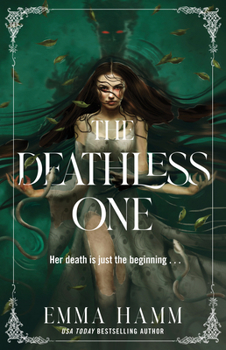
Instant USA TODAY bestseller A princess murdered at the altar makes a deal with the god of death for vengeance and to save her people in this first in a unique romantasy trilogy from USA TODAY bestselling author Emma Hamm. Jessamine was raised to be a leader for her people, but when the land is overrun by an incurable plague, she must enter a political marriage to save them all. A union that should have brought hope only brings death as her new husband murders her at the wedding altar and seizes the throne. But her death is just the beginning. Her spirit is met by the Deathless One, a god of death yearning to return to the mortal plane, and he needs her help. The two of them make a deal--her life and the return of her kingdom in exchange for his resurrection. But the Deathless One is a known trickster, and a deal with him is one made in blood. Jessamine knows the Deathless One is a dangerous ally, but the longer they work together, the more she wants him and the less she can stay away. As their connection deepens, soon she wonders if she even wants this contract to end. Perhaps the more appealing throne is the one by his side, but she'd have to turn her back on her people to get it.
Format:Paperback
Language:English
ISBN:1668063123
ISBN13:9781668063125
Release Date:August 2025
Publisher:Gallery Books
Length:336 Pages
Weight:1.90 lbs.
Dimensions:0.9" x 5.3" x 8.2"
Customer Reviews
2 ratings
Confused Narrative that Doesn't Deliver on its Marketing Promises
Published by xfildchild , 3 months ago
This book had a lot of potential: a compelling premise, yummy romance tropes, and a feminine rage core. But it ultimately disappoints, not really due to bad writing, but due to incomplete and inconsistent worldbuilding and a failure to deliver on its promise. This was marketed as a book that makes a statement on feminine rage, and I guess my problem is, I don't think it can decide what statement it is making. It's as if the publisher sold and marketed a different story than the one the author wrote, and then hired an editor that tried to bridge the two but was unsuccessful.
Jessamine is a coddled princess with no idea of the reality of the kingdom her family rules, and that can be a great basis to a character arc. It would have been a lot more fun to read had her moments of realization and personal growth not been so insufferable. Her inner monologue is whiny and self-pitying, trying to make the reader feel bad for her in the face of her people's suffering. Rather than be horrified by what her people actually endure and how everyone around her hid it from her, she is horrified by the fact that she is apparently so coddled she doesn't know how to talk to "common people" or make friends because she is too elite. It happens over and over again, and after the fifth or sixth time, it's pretty insufferable. She also doesn't ever take any action to help her people, other than scrawl a few messages on a wall after months of hiding. So she spends all of her time feeling sorrier for herself than her people. There is no personal growth at all.
The greater issue is with the worldbuilding. The origin of the Gods, the witches and how they receive and keep their power, and the origin of the plague itself are muddled and confused. But more than that, for a story that is very good at providing badass, on-the-nose quotes about how women should be empowered and free and how witches are rebels that refuse to live within the oppressive chains of patriarchy, it should really have the worldbuilding to back it up. But when the witches in the story are cunning villains who are subservient to evil gods for their power yet also somehow take advantage of those same gods for their own selfish gain, then it really takes the teeth out of those fiery passages about how righteous they are. It all ends up reading like insincere and performative feminist slop for the sake of selling books.
And the thing about witches that makes them such successful symbols of feminine rage is that their power comes from their own inner conviction to live their lives on their own terms, to spit in the face of the systems of oppression that try to limit them. That's what makes them an enduring symbol of feminism throughout history and literature. So you can't have a feminist monologue on one page and then have a sniveling, whiny princess get on her knees to beg a god to give her access to her own power on the next. The two story points are diametrically opposed.
The romance is more of a sub-plot than the main point, which I don't have an issue with. I just think this was another problem with how the book was marketed, which was as a spicy romance set in a fantasy realm, so I was just expecting something different. Our MMC is definitely a shadow daddy, but that is a difficult trope to convey successfully, because we have to sympathize with him despite his morally gray nature, and I just...didn't. He is clearly very traumatized by the witches that hurt him in the past, but he also was the one who set up the whole scenario such that they are meant to sacrifice him over and over to access their power? And he is out for revenge against all witches because they tried to save humanity from a plague that may or may not have magical origins to begin with? Then they somehow fail and are persecuted to the point of extinction and he still wants revenge for a scenario that he is essentially responsible for? I don't know, the whole thing was very confusing and did not make any sense to me.
Loved it
Published by Idabel , 4 months ago
Story line is great and very creative. Relationship building is strong, the suspense sits perfectly, it's there but doesn't leave you realing. I thoroughly enjoyed this book.
Copyright © 2026 Thriftbooks.com
Terms of Use | Privacy Policy | Do Not Sell/Share My Personal Information | Cookie Notice | Cookie Preferences | Accessibility Statement
ThriftBooks ® and the ThriftBooks ® logo are registered trademarks of Thrift Books Global, LLC
ThriftBooks ® and the ThriftBooks ® logo are registered trademarks of Thrift Books Global, LLC
