


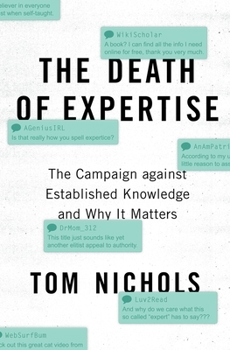
The Death of Expertise: The Campaign Against Established Knowledge and Why It Matters


Select Format
Select Condition 
Book Overview
A cult of anti-expertise sentiment has coincided with anti-intellectualism, resulting in massively viral yet poorly informed debates ranging from the anti-vaccination movement to attacks on GMOs. As Tom Nichols shows in The Death of Expertise, there are a number of reasons why this has occurred-ranging from easy access to Internet search engines to a customer satisfaction model within higher education.
Format:Paperback
Language:English
ISBN:0190865970
ISBN13:9780190865979
Release Date:October 2018
Publisher:Oxford University Press
Length:280 Pages
Weight:0.75 lbs.
Dimensions:0.7" x 5.5" x 8.2"
Customer Reviews
2 ratings
Resist the Cult of Ignorance
Published by Randy Ehrler , 1 year ago
Tom Nichols’ The Death of Expertise really made me think about why so many people have lost trust in experts. He explains how the internet makes all information seem equal, how universities now treat students like customers, and how the news focuses more on entertainment than truth. Instead of making us more informed, easy access to information has led many to reject expertise, believing all opinions carry the same weight, no matter the knowledge behind them.
I appreciated that Nichols doesn’t just blame the public—he also points out that some experts have talked down to others, creating frustration and distrust. He argues that we need public intellectuals who share knowledge with humility, not superiority. What stood out most to me was his warning: our world is complex, and ignoring expertise can have serious consequences. Just because we don’t fully understand someone’s work doesn’t mean it isn’t essential. Dismissing experts may feel good in the moment, but it can lead to real problems down the road. An essential message for our times.
Rather elitist, but interesting nonetheless
Published by Zella Paige , 3 years ago
This is an incredibly interesting, informative, and well-argued read. The book has the vibe of a well-researched and well-supported opinion piece. As such there are a couple of short sections of the book that I entirely disagree with the author on. Upon reflection, I found it interesting that those sections are supported with anecdotal rather than peer-reviewed evidence. (The two sections I'm referring to only account for about 10 pages of the book as a whole, so overwhelming I agree with Nichols and his reasoning.)
As someone outside academia, who would be classified as a layperson, some sections of this book felt alienating. Once I pushed passed that alienating feeling however I found it to be an incredibly rewarding read. As Nichols points out,
"It's not supposed to be easy." (76)
Nichols is specifically referring to the experience of receiving a college education with this sentence, but I would argue that this sentiment should and could be extrapolated to all elements of furthering education.
I think the book would have been greatly improved by collaboration with even a single additional contributor. Specifically because in the 6th chapter of the book Nichols talks at some length about the cross-expertise violations.
"[Experts] see their expert knowledge as a license to hold court about anything. (Again, I cannot cast the first stone here.)"
Despite this marked level of self-awareness on page 188, Nichols, an expert on National Security Affairs and more broadly politics, did not choose to collaborate with a communications or public affairs expert. This book was initially formulated as an article, in which case it makes sense for Nichols to be the only contributor. As it transitioned from article to book there should have been additional voices included in the writing process. In no way does this lack of additional authors take away from the validity of the book or the information it presents. I do think however that additional contributing voices could have taken this book from good to great.
I will absolutely be recommending this book (if with a few caveats) and will likely reread it myself at least once. I also left this book with a much longer reading list than prior to cracking the spine, which I think is the mark of a well-referenced read. Ultimately I feel like a more well-informed citizen for having taken hours to read The Death of Expertise.
Copyright © 2026 Thriftbooks.com
Terms of Use | Privacy Policy | Do Not Sell/Share My Personal Information | Cookie Notice | Cookie Preferences | Accessibility Statement
ThriftBooks ® and the ThriftBooks ® logo are registered trademarks of Thrift Books Global, LLC
ThriftBooks ® and the ThriftBooks ® logo are registered trademarks of Thrift Books Global, LLC
