


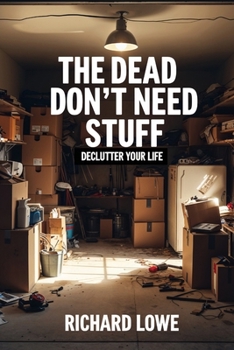
The Dead Don't Need Stuff: Declutter Your Life

Dead People Don't Need Stuff: A Hilariously Honest Guide to Decluttering Your Life
Richard Lowe grew up in a hoarding household. By the time his parents died, they had a one-bedroom apartment packed floor-to-ceiling with pathways to navigate between the piles, plus two storage units full of "valuable" items they paid monthly rent on but never saw again. When his father died, Lowe was 3,000 miles away. A social worker called, described the apartment, and asked what to do with everything. He told her to donate it all. That was the estate settlement.
This is the book he wishes someone had put in his parents' hands thirty years earlier.
Lowe has executed seven major decluttering campaigns over his lifetime. He made thirty-five thousand dollars in his first serious eBay purge. He also nearly destroyed a prized collection of Tournament of Roses pins because he got so deep into purge momentum that he stopped being able to tell the difference between clutter and the things that actually mattered to him. Both experiences taught him something most decluttering books miss entirely: knowing when to stop is harder than knowing when to start.
Dead People Don't Need Stuff is not a minimalism manifesto. It does not ask you to own fewer than a hundred things, photograph your belongings while thanking them for their service, or live in a space that looks like a waiting room. The goal is not to own less. The goal is to own honestly, which is a different thing entirely.
The book covers the psychology underneath accumulation, because no practical system sticks without it. Lowe explains why your brain is wired to keep everything, how objects absorb the emotional context of how you acquired them, and why a houseful of stuff bought during depressive episodes quietly generates a low hum of bad feeling you stop noticing until it's gone. Then it walks through the practical systems: the four-pile sorting method, the emergency purge of items that could ruin your marriage or get you arrested if the wrong person found them, twenty decluttering excuses and why every one of them is costing you something right now, a room-by-room approach that accounts for the specific psychology of each space, and maintenance habits that prevent the whole thing from quietly rebuilding itself within a year.
The family in these pages is real. Jerry's garage full of outdoor gear for activities he never did. Valerie's kitchen packed with appliances bought for the person she thought she would become. A maternal grandmother with filing cabinets of UFO research she was convinced would matter when the aliens arrived. These are not cautionary tales invented for the book. They are the destination that road leads to, described in enough detail that you can see it clearly and choose a different direction.
You are alive. Dead people don't need their stuff because they are finished. The question this book keeps asking is what you are doing with the time, space, and attention your accumulated possessions are currently consuming on your behalf.
Customer Reviews
ThriftBooks ® and the ThriftBooks ® logo are registered trademarks of Thrift Books Global, LLC
