


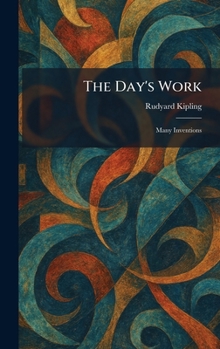
The Day's Work: Many Inventions

"The Day's Work: Many Inventions" brings together two significant collections of short stories by Rudyard Kipling, a master of the short form and one of the most celebrated writers of his era. This volume showcases Kipling's extraordinary range, blending technical precision with imaginative storytelling. In "The Day's Work", Kipling explores the spirit of professionalism and the interconnectedness of the modern world through tales of engineering, maritime adventure, and the administrative machinery of the British Raj. Notable stories such as "The Bridge-Builders" and "007" exemplify his fascination with technology and the personification of machines.
"Many Inventions" continues this exploration of human ingenuity and the supernatural, featuring beloved tales like "In the Rukh", which introduces the character of Mowgli in an adult context. The collection traverses various settings, from the high seas to the bustling streets of London and the vast landscapes of India. Kipling's prose captures the complexities of duty, the harshness of nature, and the intricacies of human character with wit and profound observation. Together, these stories offer a rich tapestry of late Victorian life and thought, cementing Kipling's legacy as a writer who could find the miraculous in the mundane and the epic in the everyday.
This work has been selected by scholars as being culturally important, and is part of the knowledge base of civilization as we know it. This work was reproduced from the original artifact, and remains as true to the original work as possible. Therefore, you may see the original copyright references, library stamps (as most of these works have been housed in our most important libraries around the world), and other notations in the work.
This work is in the public domain in the United States of America, and possibly other nations. Within the United States, you may freely copy and distribute this work, as no entity (individual or corporate) has a copyright on the body of the work.
As a reproduction of a historical artifact, this work may contain missing or blurred pages, poor pictures, errant marks, etc. Scholars believe, and we concur, that this work is important enough to be preserved, reproduced, and made generally available to the public. We appreciate your support of the preservation process, and thank you for being an important part of keeping this knowledge alive and relevant.
Customer Reviews
ThriftBooks ® and the ThriftBooks ® logo are registered trademarks of Thrift Books Global, LLC
