


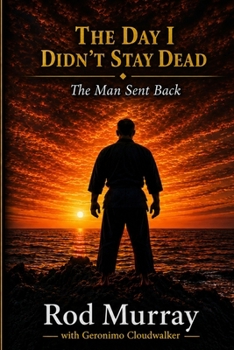
The Day I Didn't Stay Dead: The Man Sent Back

The Day I Didn't Stay Dead: The Man Sent Back is the story of a man who spent most of his life learning how to win-until the night winning became useless.
Rod Murray had been a wrestler, martial artist, police officer, businessman, casino operator, husband, and father. He knew competition, authority, money, violence, ambition, failure, and the stubborn belief that almost any problem could be solved if a man stayed strong enough, moved fast enough, or simply refused to quit.
Then a karate strike damaged his throat.
Hours later, in an Oregon hotel room with his son asleep nearby, Murray found himself on the floor, unable to call for help and increasingly unable to breathe. The telephone was only a few feet away.
He could not reach it.
For the first time in his life, there was nothing left to fight.
What followed became the dividing line of his life: an experience of separation, judgment, memory, shame, surrender, and return that he has spent decades trying to understand without turning it into something larger than he can honestly claim.
He came back.
But coming back did not make him enlightened.
It made him responsible.
The Day I Didn't Stay Dead is not simply a near-death story. It is the story of the man who went down on that floor-and the long, imperfect life required to understand what returning meant.
It moves through northern Minnesota, wrestling rooms, police work, Lake Tahoe casinos, martial-arts tournaments, business empires, marriages, fatherhood, devastating loss, Jewish study, conversion, and eventually Israel. Along the way, Murray confronts the same things most people spend a lifetime avoiding: pride, regret, anger, grief, failure, love, mortality, and the painful distance between the person we think we are and the person our choices reveal.
Running beneath the memoir is a question Murray inherited from his father, Kenneth "Mouse" Murray, a survivor of the sinking of the USS Gambier Bay during World War II:
Why was I spared?
Years later, his son would ask the same thing.
The answer did not arrive as a voice from Heaven, a grand mission, or a clean transformation. Life after the hotel-room floor still included mistakes. Pride survived the revelation. Marriages could fail. Children could be lost. Grief could return without permission. Faith did not make suffering simple, and survival did not make one life more valuable than another.
That is what makes this memoir different.
Murray does not present himself as a saint, guru, or man with all the answers. He does not ask the reader to accept his experience as proof of what happens after death. He tells what he remembers, what changed, what did not, and what he came to believe a second chance demands:
Responsibility. Repair. Humility. And honest use of whatever time remains.
For fighters, survivors, fathers, sons, seekers, skeptics, late bloomers, and anyone who has ever looked at their own life and wondered Why am I still here?, The Day I Didn't Stay Dead asks a harder question:
If you were given your life back, what would you do with it?
This is not a sermon about dying.
It is a memoir about what happens after survival-when the miracle, if it was one, is over and the real work begins.
Coming back did not make Rod Murray holy.
It made him responsible.
Customer Reviews
ThriftBooks ® and the ThriftBooks ® logo are registered trademarks of Thrift Books Global, LLC
