


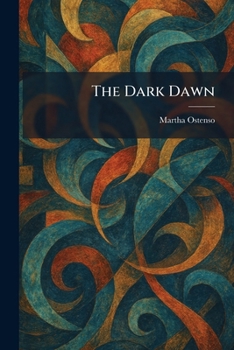
The Dark Dawn

Select Format
Select Condition 
Book Overview
"The Dark Dawn" is a compelling psychological drama set against the stark and unforgiving landscape of the North American prairie. Written by Martha Ostenso, a prominent voice in early twentieth-century realism, the novel explores the suffocating constraints of a loveless marriage and the heavy price of ambition. The story centers on Lucian Dorrit, a young man with noble intentions who finds himself trapped in a life he did not choose after marrying the domineering and calculated Hattie Murker. As Hattie's relentless drive for social standing and control begins to erode Lucian's spirit, the narrative delves deep into themes of moral entrapment, the isolation of rural life, and the harsh realities of the human condition.
With its evocative prose and keen psychological insight, "The Dark Dawn" captures the tension between individual desire and the cold expectations of a pioneer community. This masterwork of rural realism remains a poignant examination of the psychological toll exacted by secrets and the desperate search for redemption in a world defined by hardship.
This work has been selected by scholars as being culturally important, and is part of the knowledge base of civilization as we know it. This work was reproduced from the original artifact, and remains as true to the original work as possible. Therefore, you may see the original copyright references, library stamps (as most of these works have been housed in our most important libraries around the world), and other notations in the work.
This work is in the public domain in the United States of America, and possibly other nations. Within the United States, you may freely copy and distribute this work, as no entity (individual or corporate) has a copyright on the body of the work.
As a reproduction of a historical artifact, this work may contain missing or blurred pages, poor pictures, errant marks, etc. Scholars believe, and we concur, that this work is important enough to be preserved, reproduced, and made generally available to the public. We appreciate your support of the preservation process, and thank you for being an important part of keeping this knowledge alive and relevant.
Customer Reviews
ThriftBooks ® and the ThriftBooks ® logo are registered trademarks of Thrift Books Global, LLC
