


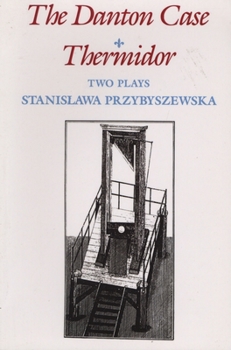
The Danton Case and Thermidor: Two Plays

Select Format
Select Condition 
Book Overview
Stanislawa Przybyszewski is recognized as a major twentieth-century playwright on the basis of her trilogy about the French Revolution, of which The Danton Case and Thermidor are the principal parts. The Danton Case depicts the battle for power between two exceptional individuals: the corrupt sentimental idealist, Danton, and the incorruptible genius of the Revolution, Robespierre. Thermidor shows the final playing out of this drama, as Robespierre, left alone with the heroic absolutist Saint-Just, foresees the ruin of himself and his cause, and in his despair predicts that hatred, war, and capitalism will steal the Revolution and corrupt nineteenth-century man.
Format:Paperback
Language:English
ISBN:0810108062
ISBN13:9780810108066
Release Date:July 1990
Publisher:Northwestern University Press
Length:297 Pages
Weight:1.08 lbs.
Dimensions:0.9" x 6.0" x 9.0"
Customer Reviews
2 ratings
I Concur with the prevoius reviewer: a masterpiece indeed!!!
Published by Thriftbooks.com User , 18 years ago
Stanislawa Przbyzewska (1901-1935) was the daughter of a well-known polish writer. Her father left her and her mother soon after she was born and for much of her life he had no contact with her. As he grew older, they became more close and she also started to write. She went to university in Cracow and stayed on there in some junior teaching position. In her late twenties she saw a few of her works (plays and essays) published, not to much acclaim however, and by then she had begun to lose her grip on her life and on her sanity. Whether it was mental illness of instability, one or more unhappy love affairs or her progressively worsening morphine addiction (and probably all of the aforementioned together) she got weirder and weirder. The last years of her life she lived as a recluse in a small wooden shack on a courtyard within the maze of 18th-century universtiy buildings. She read and she wrote. Feverishly so. Mostly about the French Revolution, and why it had gone so spectacularly wrong: it began in 1789 with the hope for a better world, and it ended in 1799 in Napoleon's authoritarean government, passing throug the bloody terror and an appalling civil war. As a pole Przbysewska had seen a revolution gone bad in her own country: Pilsudski made a new and free Poland after the first world war, but soon made himself the head of state and of the governement. In Russia, next to Poland, it had gone even worse: the Bolshevik experiment had degenerated in Lenin's terror and Stalin's terror was getting up steam by the 1930s. Przbysewska, living like an ascetic, strange, hallucinating hermit wrote and rewrote her plays. Her views on the French Revolution and particularly on the chief protagonists (Robespierre, St-Just, Danton, Desmoulins, Fabre) of its most exciting period (1793-1794) are still valid, fresh and refreshingly different. So what if she is way too far into Robespierre. Robespierre was as ascetic and uninterersted in material things as she was herself and that must have appealed to her: like him she only lived for her work. She is never dogmatic and never makes the characters into caricatures, as so many writers do: Danton the lust-for-life and larger-than-life big old brute with the golden heart and Robespierre the sneaky, utterly humourless, friendless fanatic. Przbysewska's Robespierre is a complex charachter, who loses sight of humanity, even if he is a very humane and caring human being: he likes animals, children and "the People". Robespierre loses sight of the fact, or deliberately shuts out the fact that the enemies of the people are people too, even if they are royalists, criminals, cooked stockbrokers, defeatists or dantonists. And so Robespierre, who by most accounts was an odd but fundamentally decent, shy and kind person becomes the personification of the Terror and of it's excesses. Przbysewska puts them all on stage and lets them speak. She does so skillfully, believably and, in my view honestly. One may not always
Overlooked Masterpiece
Published by Thriftbooks.com User , 26 years ago
Brilliant, obsessive and painfully overlooked as a playwright, Stanislawa Przybyszewska was able to turn her life time fascination with the Revolution into a compelling if highly idiosyncratic recounting of 1794. Very difficult to understand for people with little background, absolutely mind-blowing for those who have studied the era. She writes as if she were talking to Committee of Public Safety. Although both plays leave a bit to be desired in the way of historical accuracy and her Robespierrism gets on your nerves, few authors are able to so successfully live in the lives and times of their characters and so keenly convey the historical ambiance and psychological nuances. Nervy, haunting and brilliant, Stanislawa's highly personal telling sheds light on our own troubled century as much as Robespierre's. A must read for anyone interested in the failure of radical social change.
Copyright © 2026 Thriftbooks.com Terms of Use
| Privacy Policy | Do Not
Sell/Share My Personal Information | Cookie Policy | Cookie Preferences | Accessibility Statement
ThriftBooks® and the ThriftBooks® logo are registered trademarks of Thrift Books Global, LLC
ThriftBooks® and the ThriftBooks® logo are registered trademarks of Thrift Books Global, LLC
