


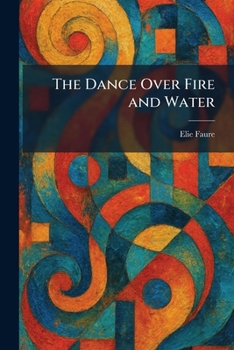
The Dance Over Fire and Water

Select Format
Select Condition 
Book Overview
"The Dance Over Fire and Water" is a profound exploration of the relationship between art, conflict, and civilization by the renowned art historian Elie Faure. In this collection of philosophical essays, Faure examines the underlying tensions that drive human creativity, arguing that the heights of artistic achievement are often born from the depths of social and political upheaval. He posits that the artist is a dancer on the edge of a volcano, finding harmony amidst the destructive forces of "fire and water" that define the human experience.
Through a series of sweeping historical and cultural observations, Faure delves into the cyclical nature of history and the vital role that tragedy plays in the development of the aesthetic spirit. He challenges traditional views of progress, suggesting instead that beauty and order are transient peaks achieved through the constant struggle of opposing forces. "The Dance Over Fire and Water" serves as a meditation on the enduring power of the creative impulse to transform chaos into meaning. Readers interested in the philosophy of art, cultural anthropology, and the history of ideas will find Faure's prose both lyrical and provocative, offering a unique perspective on how humanity navigates the turbulent currents of existence through the lens of art.
This work has been selected by scholars as being culturally important, and is part of the knowledge base of civilization as we know it. This work was reproduced from the original artifact, and remains as true to the original work as possible. Therefore, you may see the original copyright references, library stamps (as most of these works have been housed in our most important libraries around the world), and other notations in the work.
This work is in the public domain in the United States of America, and possibly other nations. Within the United States, you may freely copy and distribute this work, as no entity (individual or corporate) has a copyright on the body of the work.
As a reproduction of a historical artifact, this work may contain missing or blurred pages, poor pictures, errant marks, etc. Scholars believe, and we concur, that this work is important enough to be preserved, reproduced, and made generally available to the public. We appreciate your support of the preservation process, and thank you for being an important part of keeping this knowledge alive and relevant.
Customer Reviews
ThriftBooks ® and the ThriftBooks ® logo are registered trademarks of Thrift Books Global, LLC
