


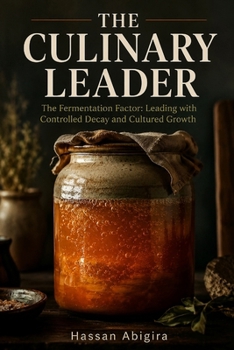
The Culinary Leader: The Fermentation Factor: Leading with Controlled Decay and Cultured Growth

There is a particular kind of team that looks flawless on paper and produces nothing memorable.
You've probably worked on one without knowing it. The org chart is clean. The processes are documented. Every meeting has an agenda. And the results are... fine. Competent. Forgettable.
Now picture a different kind of team - messier, harder to control, and somehow producing work nobody else on the market can match.
The difference isn't talent, budget, or strategy. It's fermentation.
In The Culinary Leader, Hassan Abigira draws on the biology of controlled decay and cultured growth to offer leaders something conventional management books rarely provide: a genuinely different model of how transformation actually happens - one built not around control, but around conditions.
Using fermentation not as a gimmick but as a rigorous, load-bearing metaphor, this book walks leaders through:
The Brine Principle - how to measure whether your culture is actually protecting people or just preserving the status quo
The Wild Fermentation Approach - how to hire and integrate unconventional talent without losing what made them valuable in the first place
Understanding the Kahm Yeast - how to spot political or opportunistic behavior on the surface of a team before it spreads
Aging and Umami - how to protect long-horizon decisions and initiatives from short-term pressure
The Probiotic Handoff - how to hand off a culture during a leadership transition without losing everything that made it work
Across sixteen practical, field-tested frameworks - including the Cultural pH Audit, the Skimming Technique, the Decision Aging Matrix, and the Fermentation Log - Abigira gives leaders a way of noticing what conventional management language too often minimizes: some of the most valuable outcomes a team can produce cannot be manufactured through direct control. They have to be cultured.
This is not a book about being hands-off. Every chapter pairs the case for patience with the case for standards, because a culture left entirely alone doesn't ferment - it just rots. Each chapter closes with "From the Fermentation Room," a short, practical section built to be tested against your own team, not just read.
Whether you're facing a quietly stagnant culture, a hiring decision, a political dynamic you can't quite name, a high-stakes call you're not sure how to pace, or a leadership transition on either side of it - The Culinary Leader meets you where you are and gives you language, frameworks, and permission for the kind of leadership that can't be rushed.
You cannot rush a culture. You can only learn to tend one.
Customer Reviews
ThriftBooks ® and the ThriftBooks ® logo are registered trademarks of Thrift Books Global, LLC
