


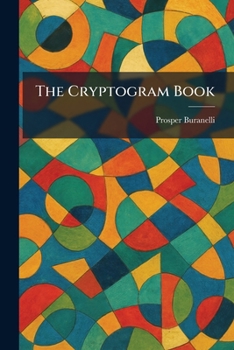
The Cryptogram Book

Select Format
Select Condition 
Book Overview
"The Cryptogram Book" serves as an engaging and intellectually stimulating collection of secret writing and substitution ciphers designed to challenge the analytical mind. Created by Prosper Buranelli, a significant figure in the history of popular puzzles, this work invites readers to step into the role of a codebreaker. The volume provides a comprehensive introduction to the fundamental principles of cryptograms, offering a series of increasingly complex puzzles that require logic, pattern recognition, and linguistic intuition to solve.
Within these pages, enthusiasts of wordplay and logic will find a diverse array of encoded messages, ranging from historical quotes to clever aphorisms. The book not only provides entertainment but also serves as a mental gymnasium, strengthening the reader's deductive reasoning and concentration. Whether for the seasoned hobbyist or the curious beginner, "The Cryptogram Book" remains a timeless resource for anyone fascinated by the art of hidden communication and the thrill of the discovery that comes with cracking a difficult code.
This work has been selected by scholars as being culturally important, and is part of the knowledge base of civilization as we know it. This work was reproduced from the original artifact, and remains as true to the original work as possible. Therefore, you may see the original copyright references, library stamps (as most of these works have been housed in our most important libraries around the world), and other notations in the work.
This work is in the public domain in the United States of America, and possibly other nations. Within the United States, you may freely copy and distribute this work, as no entity (individual or corporate) has a copyright on the body of the work.
As a reproduction of a historical artifact, this work may contain missing or blurred pages, poor pictures, errant marks, etc. Scholars believe, and we concur, that this work is important enough to be preserved, reproduced, and made generally available to the public. We appreciate your support of the preservation process, and thank you for being an important part of keeping this knowledge alive and relevant.
Customer Reviews
ThriftBooks ® and the ThriftBooks ® logo are registered trademarks of Thrift Books Global, LLC
