


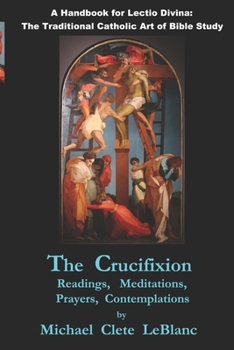
The Crucifixion: Readings, Meditations, Prayers, Contemplations
No Customer Reviews

Lectio Divinia is a traditional method of understanding sacred text from the Order of St. Benedict. The Order was adopted in 534 AD, yet modified by many, if not all of the religious communities, beginning in the Middle Ages and continuing to the present, both in Western and Eastern Orthodox traditions. Lectio Divina has four movements:
-1- The reader first seeks a Chosen Word of perhaps a phrase buried within a sacred text. Upon being read, the Word ignites a question or indeed many questions that the reader seeks more fully to understand.
-2- That Chosen Word leads to a Meditation on its meaning, both based on the text itself and upon our experiences.
-3- The Word and its meaning next infuses a Prayer. As we shall see, there are various kinds of prayers, some of which are intercessions, others acknowledge blessings, and yet others that ask for forgiveness. Some prayers are those of awe.
-4. In the final phase, Contemplation seeks unity in the Chosen Word, Meditations, and Prayers. To practice Lectio Divinia, the book presents the text and an index of Crucifixion Gospels; illustrations of the traditional and scriptural Stations of the Cross; and word cloud drawings depicting the frequency of sacred key words. The Gospel text is presented with separate accounts of five personages: Judas Iscariot, Simon Peter, Pontius Pilate, Simon of Cyreme, and Joseph of Arimathea. And so, for example, we read about the role of Judas Iscariot in a series of readings one after another as told by Matthew, Mark, Luke and John. Each personage is presented in turn so that we see each personage from four different perspectives.
-1- The reader first seeks a Chosen Word of perhaps a phrase buried within a sacred text. Upon being read, the Word ignites a question or indeed many questions that the reader seeks more fully to understand.
-2- That Chosen Word leads to a Meditation on its meaning, both based on the text itself and upon our experiences.
-3- The Word and its meaning next infuses a Prayer. As we shall see, there are various kinds of prayers, some of which are intercessions, others acknowledge blessings, and yet others that ask for forgiveness. Some prayers are those of awe.
-4. In the final phase, Contemplation seeks unity in the Chosen Word, Meditations, and Prayers. To practice Lectio Divinia, the book presents the text and an index of Crucifixion Gospels; illustrations of the traditional and scriptural Stations of the Cross; and word cloud drawings depicting the frequency of sacred key words. The Gospel text is presented with separate accounts of five personages: Judas Iscariot, Simon Peter, Pontius Pilate, Simon of Cyreme, and Joseph of Arimathea. And so, for example, we read about the role of Judas Iscariot in a series of readings one after another as told by Matthew, Mark, Luke and John. Each personage is presented in turn so that we see each personage from four different perspectives.
Format:Paperback
Language:English
ISBN:B0G6SQWWHP
ISBN13:9798276208374
Release Date:December 2025
Publisher:Independently Published
Length:222 Pages
Weight:0.67 lbs.
Dimensions:0.5" x 6.0" x 9.0"
Customer Reviews
0 rating
Copyright © 2026 Thriftbooks.com Terms of Use
| Privacy Policy | Do Not
Sell/Share My Personal Information | Cookie Policy | Cookie Preferences | Accessibility Statement
ThriftBooks® and the ThriftBooks® logo are registered trademarks of Thrift Books Global, LLC
ThriftBooks® and the ThriftBooks® logo are registered trademarks of Thrift Books Global, LLC
