




Select Format
Select Condition 
Book Overview
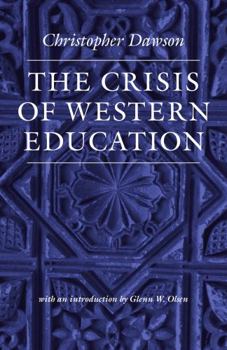
The Crisis of Western Education, originally published in 1961, served as a capstone of Christopher Dawson's thought on the Western educational system. Long out of print, the book has now been updated with a new introduction by Glenn W. Olsen and is included in the ongoing Works of Christopher Dawson series. In all of his writings, Dawson masterfully brings various disciplinary perspectives and historical sources into a complex unity of expression and applies them to concrete conditions of modern society. Dawson argued that Western culture had become increasingly defined by a set of economic and political preoccupations ultimately hostile to its larger spiritual end. Inevitably, its educational systems also became increasingly technological and pragmatic, undermining the long standing emphasis on liberal learning and spiritual reflection which were hallmarks of the Christian humanism that created it. In this important work on the Western educational system, Dawson traces the history of these developments and argues that Western civilization can only be saved by redirecting its entire educational system from its increasing vocationalism and specialization. He insists that the Christian college must be the cornerstone of such an educational reform. However, he argued that this redirection would require a much more organic and comprehensive study of the living Christian tradition than had been attempted in the past. Dawson had reservations about educational initiatives that had been developed in response to this crisis of education. Among them, he expressed doubts about newly emerging great books programs fearing that they would reduce the great tradition of a living culture to a set of central texts or great ideas. In contrast, he insisted that a Christian education had to be concerned with ""how spiritual forces are transmitted and how they change culture, often in unexpected ways."" This would require an understanding of the living and vital character of culture. As Dawson saw it, ""culture is essentially a network of relations, and it is only by studying a number of personalities that you can trace this network."" Dawson offers a diagnosis of modern education and proposes the retrieval of an organic and living culture which alone has the power to renew Western culture.
Format:Paperback
Language:English
ISBN:0813216834
ISBN13:9780813216836
Release Date:February 2010
Publisher:Catholic University of America Press
Length:192 Pages
Weight:1.10 lbs.
Dimensions:0.7" x 5.5" x 8.5"
Customer Reviews
1 rating
The Crisis of Western Education
Published by Thriftbooks.com User , 16 years ago
Decades ago ago an English historian/sociologist, Christopher Dawson, published The Crisis of Western Education (Garden City, NY: Image Books, 1965). It deserves recurrent consideration, in part because of its clearly Christian convictions. Half of the book, Part One, details "the history of liberal education in the West" and provides a highly instructive delineation of develop¬ments basic to higher education in Western Culture. Initially, the "liberal education" which took root in Hellenism largely focused on "the art of speech and persuasion, an exact knowledge of the value of words and an understanding of the laws of thought and the rules of logic" (p. 10). It was a great achievement, lacking only "its final spiritual goal," which Christianity supplied. Both Eastern (e.g. the Cappadocians) and West¬ern Church Fathers blended Hellenism's "liberal arts" with Christian theology, creating distinctive edu¬cational programs. In the Latin-speaking West, following the conversion of the many Germanic "barbarians" who populated the area, universities as well as Gothic cathedrals accompanied the "rise of vernacular culture" in the High Middle Ages. It was a vigorous intellectual epoch. providing first rate educational programs saturated with Christian principles and objectives. Though medieval "scholasticism" is often disparaged by modern critics, in its own era it was fresh and innovative, capable of challenging and captivating some of the best minds the world has known. Subsequent developments in the Renaissance and Reformation significantly altered the Medieval synthesis, but it took the eighteenth century Enlightenment to shatter it. "Thus the combination of Cartesian rationalism, Newtonian physics and Lockian empiricism produced a highly explosive compound which detonated in the second half of the eighteenth century and almost destroyed the traditional threefold order of Christendom--Church and State and Study" (p. 47). This revolution of the mind antedated and then sustained the political and industrial revolutions which have shaped the modern world, a world lacking many Christian components. During the past two centuries educational programs have increasingly served national, industrial, secular interests. In the United States, despite early efforts to synthesize education and religion in the old English tradition, schools influenced by men such as Horace Mann, who disliked religious education and championed "state control and public support," remodeled themselves according to the German pattern, and stressed "democratic moral values and the ideals of national patriotism rather than any religious doctrine or ethos" (p. 67). Such tendencies clearly distinguished the thought of Lester Frank Ward and John Dewey, who so influenced American education in this century. Consequently, whether studying Europe or America, "the crisis of Western education" looms large. So in Part Two of the book Dawson addresses "the situation
Copyright © 2026 Thriftbooks.com Terms of Use
| Privacy Policy | Do Not
Sell/Share My Personal Information | Cookie Policy | Cookie Preferences | Accessibility Statement
ThriftBooks® and the ThriftBooks® logo are registered trademarks of Thrift Books Global, LLC
ThriftBooks® and the ThriftBooks® logo are registered trademarks of Thrift Books Global, LLC
