


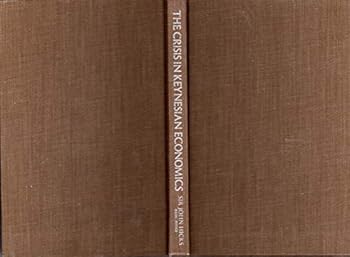
Crisis In Keynesian Economic


Select Format
Select Condition 
Book Overview
No Synopsis Available.
Format:Hardcover
Language:English
ISBN:0465014801
ISBN13:9780465014804
Release Date:February 1975
Publisher:Basic Books
Length:85 Pages
Weight:0.52 lbs.
Customer Reviews
1 rating
The crisis in Keynesian economics is really a crisis for the economics profession
Published by Thriftbooks.com User , 18 years ago
In chapter 21 of the GT,which actually includes section 4 of chapter 15 as its introduction,Keynes generalized the equation of exchange so as to incorporate the store of value effect represented by Keynes's updated analysis of the propensity to hoard under the new term liquidity preference.KEYNES MADE IT CLEAR THAT LIQUIDITY PREFERENCE IS BEHAVIOR IN CIRCUMSTANCES OF UNCERTAINTY(ELLSBERG'S AMBIGUITY),NOT RISK.Keynes had already given a complete logical,epistemological,and mathematical analysis of uncertainty under the name "the weight of the argument(evidence)" in chapters 6(26,sections 7 and 8).High weight means low uncertainty(low ambiguity) and low weight means high uncertainty(high ambiguity).Keynes integrated his mathematical analysis of the weight of the evidence,w,where w is defined on the unit interval [0,1]into his conventional coefficient of risk and weight,c,as specified in chapter 26 of the A Treatise on Probability(1921;TP).Keynes incorporates his weight of the evidence variable,w,into the elasticities e and ed subscript on pp.305-306 of the General Theory(1936;GT).The conditions required for neoclassical risk analysis to be operational at the macroeconomic level ,so that there is only a transactions demand for money used strictly as a medium of exchange,is that e=1 and ed subscript=1.This is equivalent to the condition in the TP that w=1.Only if w=1 can a single,unique normal probability distribution be defined .Only then can velocity ,V ,in the equation of exchange model ,MV=PO,where M is the supply of money,P is the aggregate price level,and O is real output ,be regarded as(1) a constant,(2)strictly proportional to nominal gdp(PO)(3)stable(around the mean of a normal probability distribution),or (4)predictable ,using the mean-variance analysis of Milton Friedman in A Monetary History of the United States,1867-1960(pp.285-286,594,etc.). The crisis in Keynesian economics occurred when the Keynesian economists ,such as Hicks,Hanson,Tobin,Heller,Solow,Klein,Modigliani,etc. attempted to replace Keynes's " liquidity preference as behavior toward uncertainty " analysis, based on w,e and ed subscript ,with a " liquidity preference as behavior toward risk " analysis where ,by definition w=1,e=1,and ed subscript =1(rho=1).In such conditions involuntary unemployment is not possible.Involuntary unemployment is only possible in the cases where w Keynes's GT is expressed in its most general form in chapter 21 of the GT, where he generalized the equation of exchange so as to explicitly incorporate the store of value function of money expressed as the speculative demand for money L2(M2).If L2(M2)>0,then w,rho,e, and ed subscript are all less then 1.If L2(M2)=0,then w,rho,e,and ed subscript are all equal to 1.An L2(M2)>0 is,of course,the same as the old propensity to hoard(what Milton Friedman called Keynes's " excessive liquidity preference ")problem, identified as such by Plato,Aristotle,Aquinas,The Scholastic philosophers,the medieval Cat
Copyright © 2026 Thriftbooks.com Terms of Use
| Privacy Policy | Do Not
Sell/Share My Personal Information | Cookie Policy | Cookie Preferences | Accessibility Statement
ThriftBooks® and the ThriftBooks® logo are registered trademarks of Thrift Books Global, LLC
ThriftBooks® and the ThriftBooks® logo are registered trademarks of Thrift Books Global, LLC
