


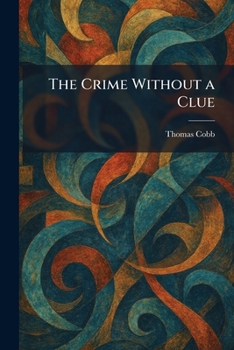
The Crime Without a Clue

Select Format
Select Condition 
Book Overview
"The Crime Without a Clue" is a classic British mystery from the Golden Age of detective fiction. This intriguing tale centers on a baffling murder that seems to defy logic. When a body is discovered under mysterious circumstances, investigators find themselves at a standstill, facing a case where clues are non-existent and motives are hidden behind a veil of respectability.
As the investigation unfolds, the narrative delves into the complexities of human nature and the secrets often concealed within society. Thomas Cobb, known for his polished prose and intricate plotting, crafts a story that keeps readers guessing until the final revelation. The novel explores themes of justice, deception, and the painstaking process of deduction required to solve a crime that initially appears unsolvable.
Fans of traditional whodunnits and vintage crime fiction will appreciate the atmosphere and pacing of this work. "The Crime Without a Clue" stands as a compelling example of the British detective novel, offering a sophisticated puzzle for the armchair sleuth to unravel.
This work has been selected by scholars as being culturally important, and is part of the knowledge base of civilization as we know it. This work was reproduced from the original artifact, and remains as true to the original work as possible. Therefore, you may see the original copyright references, library stamps (as most of these works have been housed in our most important libraries around the world), and other notations in the work.
This work is in the public domain in the United States of America, and possibly other nations. Within the United States, you may freely copy and distribute this work, as no entity (individual or corporate) has a copyright on the body of the work.
As a reproduction of a historical artifact, this work may contain missing or blurred pages, poor pictures, errant marks, etc. Scholars believe, and we concur, that this work is important enough to be preserved, reproduced, and made generally available to the public. We appreciate your support of the preservation process, and thank you for being an important part of keeping this knowledge alive and relevant.
Customer Reviews
ThriftBooks ® and the ThriftBooks ® logo are registered trademarks of Thrift Books Global, LLC
