


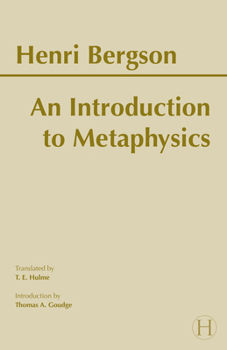
An Introduction to Metaphysics


Select Format
Select Condition 
Book Overview
In 'An Introduction to Metaphysics' Bergson develops his conception of the two essential ways of knowledge about the reality. On the one hand is the analytical, the solid, and permanently defined,... This description may be from another edition of this product.
Format:Paperback
Language:English
ISBN:087220474X
ISBN13:9780872204744
Release Date:September 1999
Publisher:Hackett Publishing Company, Inc.
Length:64 Pages
Weight:0.20 lbs.
Dimensions:8.5" x 0.3" x 5.5"
Customer Reviews
5 ratings
Informative
Published by Thriftbooks.com User , 20 years ago
A great starting place for someone considering the study of metaphysics. This short treatise will help your understanding of the field and propel you into further and deeper study.
Intellectual Intuition
Published by Thriftbooks.com User , 20 years ago
I haven't read this work in a while, though I read it many times at various points in my adult life. It does, however, stand out for me as the most difficult subject that Philosophy has yet to answer. Or, can it be answered, is probably closer to the point. This is the problem of what we call Intuition. For Bergson, Intuition is a definite, cognative thing. While it might not reflect modern thinking on the mind-brain as a bio-mechanism, this does not mean that it is wrong. In fact, it might well be better to ask is the current view wrong because Bergson doesn't fit within it? Bergson is set apart from most of his French counterparts like Sartre because his philosphy tends to go after niche subjects, such as Time, Laughter, and Intuition. Issues that rarely get attention by "serious" Philosophy. His works have been discredited by Bertrand Russell only to see a rennaisance of sorts in view of the darkness left by Russell and his logically minded cronies. This specific book is probably an interesting starting point for Bergson. It allows the reader to ask questions along the way. Since these are lectures, there is a broad latitude given to the subject at hand. Metaphysics is not a subject that anyone has successfully defined, unless its by negation, so I will not endeavor to explain it. But, the clear area that Bergson seems to wish to cover is that Intuition is not some primal instinct nor is it a superstition, but rather a complex function of the mind.
An Interesting work of Metaphysics/Epistemology
Published by Thriftbooks.com User , 24 years ago
"An Introduction to Metaphysics," is less an introduction to metaphysics than a criticism of its previous ideas. Bergson provides very interesting criticisms of empiricism and rationalism as well as interesting solutions to these problems. Bergson is one of the more intriguing of 20th Century Philosophers and I found this work enjoyable enough to recommend it to anyone with an interest in AND knowledge of the subject. However, if you are looking for an ACTUAL introduction to metaphysics, look elsewhere. Might I suggest starting with Aristotle?
valuable despite of any flaws
Published by Thriftbooks.com User , 25 years ago
This book is composed of two introductory essays accompanied by several other essays from various period's in Bergson's life. Thus, there is no flow in the book; one can probably start on any of the essays. However, because the book lacks a direct flow of thought, I found it necessary to often go back and reread sections that are further elaborated on elsewhere. Prior to this book, i was only familiar with Bergson through Deleuze, yet Bergson does not assume that his reader is familiar with concepts such as "duration" that are developed more completely elsewhere and gives adequate explanations in "The Creative Mind." Bergson's main task in this book is to explore "philosophical intution". He admirably points out the necessity for such a way of knowing, namely, its abilty to grasp pure movement, duration. He argues against the idea that philosophy should attempt to be a grand synthesis of positive science and instead argues that philosophy should be complementary to science, such that they have "points in common" at which they can verify one another. In addition to this, there are several other topics discussed, such as the "possible" in relation to the "real". Overall, although i really enjoyed reading this book as it is full of clever insights and is written with an honesty and passion that is rare in philosophy, i find that Bergson ultimately fails to distinguish metaphysics from science in the manner in which he desires. Despite this, as the title suggests, this is a book that encourages us to recognize what is unique and novel in things, including our own thought, as opposed to thinking of ourselves and other thinkers as merely part of a historical norm and things as existing only in relation to some higher essence-- that is, what is unique and novel in things, their essence, comes from within and is immanent to the things themselves and does not come "from above".
Great book for students considering Metaphysics.
Published by Thriftbooks.com User , 25 years ago
The author Bergson has written a book that is ideal for students and or anybody considering studying or learning about "Metaphysics". However, I personally feel that somebody who is not a philosopher would do better to study some of Aristotle before looking into studying metaphysics. Nevertheless this book does it's job and does it well in the introduction of metaphysics by telling the reader what it's good for and why it's worthless. Having a good understanding of the benefits of studying metaphysics is truly the best way to pursued somebody into studying metaphysics. If your considering studying of metaphysics, good for you, I suggest you buy this book.
Copyright © 2026 Thriftbooks.com Terms of Use
| Privacy Policy | Do Not
Sell/Share My Personal Information | Cookie Policy | Cookie Preferences | Accessibility Statement
ThriftBooks® and the ThriftBooks® logo are registered trademarks of Thrift Books Global, LLC
ThriftBooks® and the ThriftBooks® logo are registered trademarks of Thrift Books Global, LLC
