


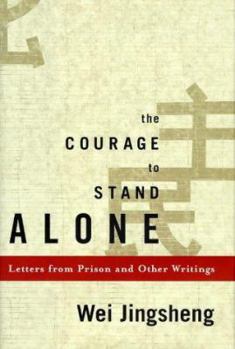
The Courage to Stand Alone: Letters from Prison and Other Writings

Select Format
Select Condition 
Book Overview
The letters of a Chinese dissident who has been imprisoned for nearly twenty years are published here, along with essays that he has written about his political beliefs and what China's economic and human rights reforms should be.
Format:Hardcover
Language:English
ISBN:0670872490
ISBN13:9780670872497
Release Date:May 1997
Publisher:Viking Adult
Length:283 Pages
Weight:1.35 lbs.
Dimensions:9.3" x 1.1" x 6.3"
Related Subjects
Asia Biographical Biographies Biographies & History Biography & History China Civil Rights & Liberties Education & Reference Essays & Correspondence Foreign Language Study & Reference Historical History Leaders & Notable People Letters & Correspondence Political Political Science Politics & Government Politics & Social Sciences Specific TopicsCustomer Reviews
4 ratings
Wei: dissident and intellectual
Published by Thriftbooks.com User , 25 years ago
Wei Jingsheng is well known as China's leading dissident, but this book also establishes him as one of China's leading intellectuals. He has the courage to see and to say what others in China cannot. His letter to Deng Xiaoping about Tibet is an extraordinarily powerful piece of writing. It is worth buying the book for this alone.
Forbidden reading in China, required reading everywhere else
Published by Thriftbooks.com User , 27 years ago
The lack of heroes these days has become a truism. Our political leaders are beset by satyriasis and mendacity. Our sports icons gobble steroids, routinely violate the terms of their parole, and sometimes even behead their wives.That makes it surprising to encounter a genuine hero, which the author of The Courage To Stand Alone certainly is. It is doubly strange that he should emerge from China, the land of groupthink and hyperconformity. Who would have thought that a child of the Cultural Revolution would become a major force for decency and dignity even as those qualities were being rendered quaint and passe by the rush for market share in the New Global Economy?When Wei Jingsheng was first put into prison and began writing the letters that make up the bulk of To Stand Alone, Mandela had been in prison for 17 years, Solzhenitsyn had just published Gulag in English, and the concept of dissent was unknown in China. When Wei was released in 1997 and flew to the US after having served 18 years in China's gulag (known there as laogai), Mandela was president of South Africa, Solzhenitsyn had returned to a free Russia, and Deng had transformed China from a socialist police state to a plutocratic police state. With all the stuff in our hardware stores and clothing shops bearing the Made in China tag, you might even think China had been transformed into a free society. You would be mistaken to think that, however. Wei was imprisoned for exercising one of the simplest and most basic rights, that of free speech. He published a magazine. In it, he urged the Chinese Communist Party to honor all the grand promises it made in the constitutions it churned out from time to time, promises like "The People have the right to speak out freely, air views fully, hold great debates, and write dazibao (large character posters posted on walls in public places for all to read)". Wei had begun his career as a dissident by putting up one such dazibao: his essay "Democracy: The Fifth Modernization". This document (included in To Stand Alone) is a piece of impassioned logic which a Jefferson or Hancock would be proud to sign. He wrote it and posted it the same night on Beijing's Democracy Wall. Unlike the others who posted writings there, Wei left his name and number. That wasn't safe, but Wei believed the Chinese were getting a worldwide reputation for spinelessness, thanks to people like Deng and Lin Biao who, during the reign of Mao Zedong, had taken the craft of brown-nosing and sycophancy to new depths. In 1979 Deng was just beginning his reign, and many thought he was a new kind of leader, which he was, in some ways. In other ways he was the oldest kind of leader there is: a tyrant. In his magazine, Wei identified him as dictator-in-the-making a full 10 years before Deng ordered the murder of hundreds of students in Tiananmen Square. That prediction put Wei in prison, the special Chinese kind of prison where you are expected to
I cannot afford a thorough reading
Published by Thriftbooks.com User , 28 years ago
As a Chinese communist party member, I'm supposed to tell a lie as usual, but I have to admit that I really love this book. However, sad stories are always hard to go over again and again, which will make me emotionally unacceptable. If I were a girl, Jingsheng, I would like to be your lover, but never your wife.
Nobody who studies Chinese politics can ignore Wei's ideas.
Published by Thriftbooks.com User , 28 years ago
"Don't give the Chinese communists too much pressure, otherwise they cannot afford to provide food for the people." That is a pretext used by many countries or people to delay the democratization of China. Wei's counter-argument was: It is the people who provide food for the communists. Why did you reverse the order? Wei's political analysis is better than a lot of people with Ph.D. degrees. He is willing to tell the obvious even in face of personal danger. From now on, people who talk about contemporary Chinese politics should start from Wei's ideas. If they do not, they should at least explain why they are avoiding them.
Copyright © 2026 Thriftbooks.com
Terms of Use | Privacy Policy | Do Not Sell/Share My Personal Information | Cookie Notice | Cookie Preferences | Accessibility Statement
ThriftBooks ® and the ThriftBooks ® logo are registered trademarks of Thrift Books Global, LLC
ThriftBooks ® and the ThriftBooks ® logo are registered trademarks of Thrift Books Global, LLC
