


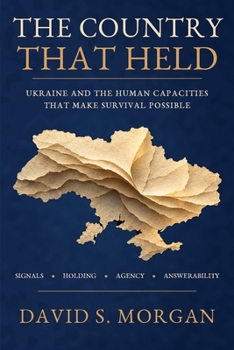
The Country That Held

When a country is attacked, who keeps everyday life from coming apart?
On the morning Russia's full-scale invasion began, Alina, a railway conductor, was bringing a train into Kyiv. Her parents were trapped in Kherson. She could not stop the war. But she could keep her carriage from becoming another place where fear took over. Hers was one of millions of consequential decisions on which a country's collective life would depend.
In The Country That Held, David S. Morgan turns from the familiar story of war as combat to the less visible work of keeping a society alive. Drawing on Ukrainian journalism, testimony, and the documentary record, he follows railway conductors and dispatchers, teachers in underground classrooms, volunteer medics, local officials, and witnesses who buried a diary beneath a cherry tree so that one day it might be read. Their decisions were rarely simple, and their costs were not evenly shared.
Through these lives, Morgan traces four capacities on which collective survival depends: recognizing danger, holding institutions together when routines break down, making action possible amid uncertainty, and keeping power answerable even under extreme pressure. These are not abstract leadership virtues. They are practices tested by the daily demands of survival, and by the question of what survival must never be allowed to become.
This is neither a celebration of heroic national character nor a comforting tale in which suffering automatically produces strength. It asks harder questions: Who performs the work of survival? Who bears its costs? What must people and institutions refuse to sacrifice, even to save themselves?
A work of narrative nonfiction about Ukraine, civilian resilience, institutional survival, and the human choices that keep collective life possible, The Country That Held ultimately turns its questions toward societies watching from a safer distance.
If those same capacities were tested in our own societies, could we count on them to hold?
Customer Reviews
ThriftBooks ® and the ThriftBooks ® logo are registered trademarks of Thrift Books Global, LLC
