


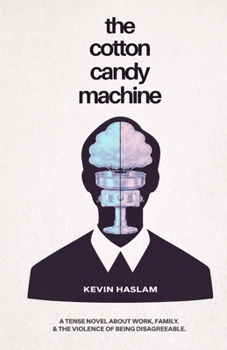
The Cotton Candy Machine

Declan's life is held together by a familiar bargain: be useful, be pleasant, be available. It's a bargain modern systems reward-until the reward becomes a leash.
At work, pressure arrives wearing a blazer and a smile. Meetings are framed as support. Emails are framed as clarity. "Alignment" is framed as teamwork. But Declan can feel what's underneath: a corporate language designed to make extraction sound like professionalism. The threat is rarely explicit. It doesn't have to be. The threat is embedded in tone, timing, and who gets copied "for visibility." It's the steady conversion of a human being into a resource whose limits are treated as inconveniences.
At home, Declan's father begins to decline. The medical world introduces its own cold choreography-waiting rooms, appointments, forms, fluorescent truth. Declan's father is not a device for inspiration; he's a man with practiced pride and decades of habit, the kind of man who refuses help until refusal becomes its own kind of cruelty. Declan is pulled into a new role he doesn't know how to perform: caretaker, advocate, son who has to face how love gets expressed in avoidance.
In the community, well-meaning "help" arrives. Food arrives. Concern arrives. Prayer arrives. But the book refuses to romanticize any of it. Public kindness can be real-and still be invasive. It can be a way of taking moral possession. It can confuse access with care.
The novel's engine is the accumulation of small confrontations. Declan begins practicing what the book calls "clean sentences"-statements that do not soften themselves into meaninglessness. He learns to say what he can do and what he cannot. He learns to stop flooding his boundaries with explanations. That shift changes the story's physics: when he stops cooperating with pressure, pressure has to show its face.
The Cotton Candy Machine is built for readers who recognize institutional dread and want it dramatized, not summarized. Its suspense comes from a practical question: what happens when a person stops being easy? The book's central claim is blunt and unusually contemporary: kindness is not a personality trait. It's infrastructure. When kindness collapses, public life becomes brittle-more volatile, more predatory, more eager to punish the simplest word in the language: no.
Customer Reviews
ThriftBooks® and the ThriftBooks® logo are registered trademarks of Thrift Books Global, LLC
