


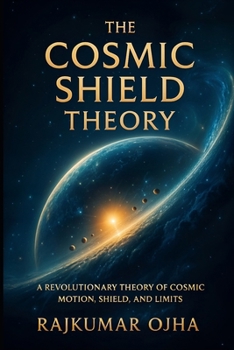
The Cosmic Shield Theory: A Revolutionary Theory of Cosmic Motion, Shield, and Limits
No Customer Reviews

The universe is not empty. What if space itself has structure, resistance, and hidden mechanics we've never accounted for? The Cosmic Shield Theory presents a bold, unified model that challenges gravity-only explanations of planetary motion, spin, and orbital stability. Rather than relying on random collisions or unknowable past events, this work proposes a mechanical framework based on cosmic drag, slipstream shielding, and positional resistance. At the center of the theory is a simple but radical idea: as the Sun moves through space, it creates a protective slipstream-an invisible shield that stabilizes planetary orbits, generates spin through friction, and defines the true limits of our solar system. Inside this book, you'll explore: why planets maintain precise, long-term orbits without drifting or collapsing how planetary spin can arise naturally from shield friction, not ancient collisionswhy asteroids from outside the system rarely penetrate inwardwhy interstellar travel may be physically constrained by space resistancehow black hole behavior mirrors simple mechanical vortex systemswhy the universe's apparent silence may be structural, not accidental
This is not speculative fiction and not a rejection of gravity.
It is a mechanical extension-a proposal that introduces cosmic drag and shielding as missing components in current models. Written with clear analogies, step-by-step reasoning, and accessible language, The Cosmic Shield Theory invites scientists, engineers, and independent thinkers to examine the universe through a different lens. You don't need to agree.
You only need to think. Once you understand the concept of the cosmic shield, the motion of planets-and the limits of deep space-will never look the same again.
This is not speculative fiction and not a rejection of gravity.
It is a mechanical extension-a proposal that introduces cosmic drag and shielding as missing components in current models. Written with clear analogies, step-by-step reasoning, and accessible language, The Cosmic Shield Theory invites scientists, engineers, and independent thinkers to examine the universe through a different lens. You don't need to agree.
You only need to think. Once you understand the concept of the cosmic shield, the motion of planets-and the limits of deep space-will never look the same again.
Format:Paperback
Language:English
ISBN:B0FH5JXP5D
ISBN13:9798291435649
Release Date:July 2025
Publisher:Independently Published
Length:54 Pages
Weight:0.19 lbs.
Dimensions:0.1" x 6.0" x 9.0"
Customer Reviews
0 rating
Copyright © 2026 Thriftbooks.com Terms of Use
| Privacy Policy | Do Not
Sell/Share My Personal Information | Cookie Policy | Cookie Preferences | Accessibility Statement
ThriftBooks® and the ThriftBooks® logo are registered trademarks of Thrift Books Global, LLC
ThriftBooks® and the ThriftBooks® logo are registered trademarks of Thrift Books Global, LLC
