


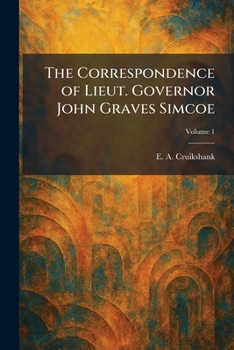
The Correspondence of Lieut. Governor John Graves Simcoe

"The Correspondence of Lieut. Governor John Graves Simcoe" (Volume 1) is a vital historical collection documenting the administrative and military life of the first Lieutenant Governor of Upper Canada. This volume provides an intimate look at the challenges of governance, defense, and settlement in a fledgling colony during the late 18th century. Through a comprehensive gathering of personal and official letters, readers gain insight into Simcoe's strategic vision for the region, his relations with Indigenous nations, and the complexities of establishing British law and institutions in the North American wilderness.
This work serves as an essential primary source for scholars and enthusiasts of Canadian history, offering a detailed perspective on the formative years of Ontario. The documents contained within reveal the logistical hurdles of the era, the political tensions between the United States and British North America, and Simcoe's unwavering commitment to the development of a loyalist society. It is an indispensable resource for understanding the foundations of Canadian political and social structures, emphasizing the historical value of 18th-century administrative records and military strategy.
This work has been selected by scholars as being culturally important, and is part of the knowledge base of civilization as we know it. This work was reproduced from the original artifact, and remains as true to the original work as possible. Therefore, you may see the original copyright references, library stamps (as most of these works have been housed in our most important libraries around the world), and other notations in the work.
This work is in the public domain in the United States of America, and possibly other nations. Within the United States, you may freely copy and distribute this work, as no entity (individual or corporate) has a copyright on the body of the work.
As a reproduction of a historical artifact, this work may contain missing or blurred pages, poor pictures, errant marks, etc. Scholars believe, and we concur, that this work is important enough to be preserved, reproduced, and made generally available to the public. We appreciate your support of the preservation process, and thank you for being an important part of keeping this knowledge alive and relevant.
Customer Reviews
ThriftBooks ® and the ThriftBooks ® logo are registered trademarks of Thrift Books Global, LLC
