


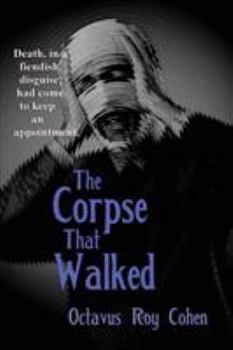
The Corpse That Walked: A Classic Mystery of Death, Deception, and Impossible Appearances

Select Format
Select Condition 
Book Overview
A fast-moving mystery built on the unsettling premise of a death that refuses to remain resolved. In The Corpse That Walked, Octavus Roy Cohen constructs a narrative in which apparent finality gives way to uncertainty, drawing the investigation into a sequence of reversals, concealments, and calculated misdirection.
Cohen's style is direct and economical, favouring momentum over elaboration. The story advances through dialogue and action, with each development reframing the central problem and narrowing the field of explanation. The tension arises not from complexity alone but from the persistent disruption of expectation, as evidence fails to align with appearance.
Representative of early twentieth-century pulp mystery fiction, the novel reflects Cohen's ability to combine a striking premise with disciplined narrative control. It will appeal to readers of classic crime fiction, concise plotting, and stories built on a single compelling anomaly.
Customer Reviews
ThriftBooks® and the ThriftBooks® logo are registered trademarks of Thrift Books Global, LLC
