


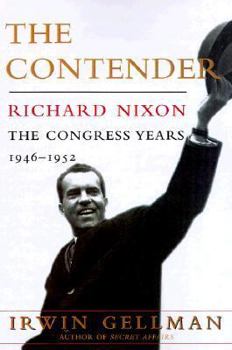
The Contender: Richard Nixon: The Congress Years, 1946 to 1952


Select Format
Select Condition 
Book Overview
The definitive account of Richard Nixon's congressional career, back in print with a new preface Unsurpassed in the fifteen years since its original publication, Irwin F. Gellman's exhaustively... This description may be from another edition of this product.
Format:Hardcover
Language:English
ISBN:0684850648
ISBN13:9780684850641
Release Date:August 1999
Publisher:The Free Press
Length:624 Pages
Weight:2.05 lbs.
Dimensions:9.8" x 1.3" x 6.5"
Customer Reviews
5 ratings
Needed correction of anti-Nixon myths
Published by Thriftbooks.com User , 17 years ago
In "The Contender, Richard Nixon, The Congress Years" historian Irwin F. Gellman sets for himself a difficult, yet needed correction of mythology posing as history: that Richard Nixon's political career was founded on smears and lies. Using actual campaign literature, contemporary newspaper accounts, letters, and government documents, Gellman methodically demolishes three Big Lies perpetrated by Nixon's loudest critics. The first lie is that Nixon used dirty tricks to win his first race for U.S. Congress in 1946. Carefully examining the record, Gellman shows that incumbent New Deal congressman Jerry Voorhis neither took Nixon seriously, nor did he realize the extent to which public opinion was shifting after the war. Gellman writes of Cong. Voorhis campaign manager father observing to his son 11 months before the General election: "On December 1, Charles informed his son that the Candidate and Fact Finding Committee (Reviewer's note: the GOP committee that recruited Nixon), in contradistinction to the spirit of the primary laws, had endorsed a Quaker named Richard Nixon, Charles optimistically predicted that his son would retain a large Quaker block because of his record. Nixon was `not very well known' and was being discharged from the navy a lieutenant commander: `It is just another campaign that we have to go through but I am quite sanguine as to the outcome. In any event, we have nothing to worry about now.' Jerry's reply was as cavalier as his father's: `I am not worried about the matter and we will just go ahead like we have before.' "Jerry and his father had badly miscalculated Nixon's success, the extent of his support, and his unifying effect on the Republican Party..." As the nation was swinging away from New Deal socialism, Voorhis hewed to the old party line in his voting. Yet even Voorhis understood the danger involved in what had become widely known: that some labor unions had been penetrated by Communists. In considering whether to accept the endorsement of the UAW-CIO labor PAC, Voorhis wrote the union leadership that he was, "deeply concerned over the degree to which Communists have succeeded in getting hold of some of the organizations, and I definitely do not want their support..." So, Cong. Voorhis rejected the state UAW-CIO labor PAC's endorsement and they obliged, listing him as not endorsed. Yet Voorhis accepted the local labor PAC's support, an inconsistent decision, given his concern for the impression that would leave. Nixon's campaign started to use the labor endorsement to its advantage - even newspapers took note of it in their endorsements of Nixon. While Cong. Voorhis stayed in Washington, D.C. through most of the campaign, not taking Nixon seriously, Nixon simply out hustled him and out organized him, winning against the incumbent by 56.1 percent to 42.7 percent. The second lie involves the Alger Hiss, Whittaker Chambers, and Sen. Joseph McCarthy. In 1948, the freshman Congressman from Cali
A Welcome Change
Published by Thriftbooks.com User , 25 years ago
I have never been very knowledgable about Richard Nixon. When I picked up this book, I was pleasantly surprised by what I learned. This book is an honest and factual portrayal of a man who served his country, and not the poobah of Watergate scandals.It is so refreshing to learn about the man and not just read criticism after criticism. Nixon's great character and accomplishments are in this book, and I recommend it to any student of political science or just fans of the genre.
In the beginning....
Published by Thriftbooks.com User , 25 years ago
For the record, this is an excellent book, and I too have read almost countless books on Nixon the last 25 years. The research is excellent, and perhaps for one of the first times we get to see Richard Nixon in the early years, without the baggage he is saddled with by people looking back. Still, there are problems with that: while Gellman can claim the early campaigns were nothing compared to later years, for their time they were shocking. It was a departure from the standards, and he was forever recognized as a campaigner that would go as far as necessary to win. The personal notes Gellman quotes from in the early years are insightful. Unfortunately, personal insights are missing by the end of the book: one wonders if Mr. Nixon stopped writing notes, or just stopped writing such personal ones. There are a surprising number of grammatical errors in the book (at least 5, perhaps more) but the surprise is due to Mr. Gellman's diligence in his research. Do not let these small errors prevent you from reading one of the few books on Nixon that attempts to provide a fresh look without apology, and without anger.
A Real Contender
Published by Thriftbooks.com User , 25 years ago
I disagree with the gentleman above. I have read over 40 books on Nixon and found 'the Contender' a cracking read. It covers in depth the period between 1946-52, from his legal and military days right up to his days as a Senator. Most other books gloss over this period but this author has delved deep into many archives to reveal the story as it was. Again other books tend to distort the facts of Nixon's early political years her you will fins the msot accurate read I have found!
The Contender: Richard Nixon, the Congress Years, 1946-52.
Published by Thriftbooks.com User , 26 years ago
Very informative and particullarly interesting to Californians. The disinformation about the Nixon campaigns is unbelievable. A good read that goes along way towards informing all of us about what RN was really like.
Copyright © 2026 Thriftbooks.com Terms of Use
| Privacy Policy | Do Not
Sell/Share My Personal Information | Cookie Policy | Cookie Preferences | Accessibility Statement
ThriftBooks® and the ThriftBooks® logo are registered trademarks of Thrift Books Global, LLC
ThriftBooks® and the ThriftBooks® logo are registered trademarks of Thrift Books Global, LLC
