
Skip to content
Scan a barcode
Scan
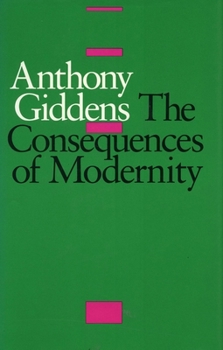
Paperback The Consequences of Modernity Book

ISBN: 0804718911

ISBN13: 9780804718912

The Consequences of Modernity

Select Format

Select Condition ThriftBooks Help Icon

Recommended

Format: Paperback

Condition: Good

$7.99
Save $17.01!
List Price $25.00
Almost Gone, Only 3 Left!

Book Overview

In this major theoretical statement, the author offers a new and provocative interpretation of institutional transformations associated with modernity. What is modernity? The author suggests, "As a first approximation, let us simply say the following: 'modernity' refers to modes of social life or organization which emerged in Europe from about the seventeenth century onwards and which subsequently became more or less worldwide in their influence."

We do not as yet, the author argues, live in a post-modern world. The distinctive characteristics of our major social institutions in the closing years of the twentieth century suggest that, rather than entering into a period of post-modernity, we are moving into a period of "high modernity" in which the consequences of modernity are becoming more radicalized and universalized than before. A post-modern social universe may eventually come into being, but this as yet lies on the other side of the forms of social and cultural organization that currently dominate world history.

In developing a fresh characterization of the nature of modernity, the author concentrates on the themes of security versus danger and of trust versus risk. Modernity is a double-edged phenomenon. The development of modern social institutions has created vastly greater opportunities for human beings to enjoy a secure and rewarding existence than in any type of pre-modern system. But modernity also has a somber side that has become very important in the present century, such as the frequently degrading nature of modern industrial work, the growth of totalitarianism, the threat of environmental destruction, and the alarming development of military power and weaponry.

The book builds upon the author's previous theoretical writings and will be of great interest to those who have followed his work through the years. However, this book covers issues the author has not previously analyzed and extends the scope of his work into areas of pressing practical concern.

Customer Reviews

3 ratings

A good primer

This is a lucid introduction to some of the key sociological themes of Giddens's theory of modernity. He outlines his case for why the so-called "postmodern" world is really just an intensification of the features of modernity (rather than a distinctive regime that has broken from modernity). But as another reviewer suggested, interest in this debate was already ebbing by 1990, and the more interesting ideas have to do with the way Giddens links modernity and globalization. For Giddens, modernity is less a kind of society or a stage of development than a set of processes that reorder social relations. In one of his oft-quoted formulas, modernity is "a 'lifting out' of social relations from local contexts of interaction and their restructuring across time and space." He offers clear and useful examples that make this abstract description easy to grasp. The book doesn't wade very far into the politically charged debates about modernity--Is modernity just a Western concept that pretends to merely describe what is actually being imposed as an ideological project? Does it make sense to talk about "multiple modernities," alternatives to Western patterns of modernity that can or should develop in different parts of the world? In _Consequences_ Giddens doesn't do more than glance at counter arguments to his own; but he didn't intend to. Serious readers will eventually want to get a bigger picture, but this introduction is a good place to start.

reflection from the Third World

In dealing the "consequences of modernity" (especially the sombre side, the dangers and risks), I am sure Giddens himself belongs to the "radical engagement" kind he describes. Not only trying to have some impact through his analysis of the situation to date, but practically participate in the "power arena" -as we know he is an important "mastermind" for the British ruling Labor Party. Thus his argument about getting into power to "make thing done" has its trail. And I can't agree more on this standpoint. However, I think he could have paid more attention to the uneven relationship between Western and Non-Western countries within modernity or globalization.Modernity is a western project in terms of the ways of life fostered by the transformative agencies of nation-state and capitalism, according to Giddens. This is "because of the power they(the West) have generated"(p174). On the other hand, modernity is NOT particularly Western from the standpoint of its globalising tendencies because "there are no others"(p175). Hence, it seems clear that the Non-Western world can only "accept" what introduced to them by a "powerful brother". The helplessness is just identical to the situation of lay population facing the expert systems-but only the latter is detailed analyzed in this book.Furthermore, I don't really understand why Giddens makes such an effort to discuss the unique of "trust" in modern era. I mean of course we have to "trust" the abstract systems. But it is the "abstract systems" not "trust" that results our difference from the pre-modern world. A per-modern person had to trust the rules of the society and something he didn't know as well (there were doctors and fortunetellers)!

Consequensence of Modernity

The title itself sounds dangerous, however, the time I read this book makes me aware how far humanities came into destroying the human race. This is the reason why I advocate to all students and reader to fight back against globalization because this is part of what the book it says. The main core of the book or Anthony Giddens thought is that reflexivity of modernity is dangerous. Human are becoming distrusted, playing something that is move by self-centered interest. I know there are consequences of modernity, that is when we abuse our knowledge or intellect, when we are using this modern technology in destruction and in wrong way.
Copyright © 2025 Thriftbooks.com Terms of Use | Privacy Policy | Do Not Sell/Share My Personal Information | Cookie Policy | Cookie Preferences | Accessibility Statement
ThriftBooks ® and the ThriftBooks ® logo are registered trademarks of Thrift Books Global, LLC

GoDaddy Verified and Secured