
Skip to content
Scan a barcode
Scan
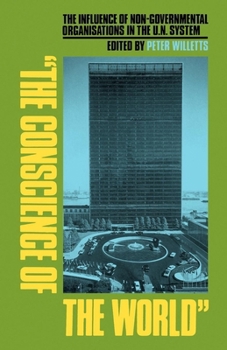
Paperback Conscience of the World: The Influence of Non-Governmental Organisations in the UN System Book

ISBN: 0815794193

ISBN13: 9780815794196

Conscience of the World: The Influence of Non-Governmental Organisations in the UN System

Private groups, such as Amnesty International and Save the Children Fund, have had a formal consultative status with the United Nations since its founding. Such groups--known as nongovernmental organizations, or NGOs--have come to exert considerable influence on the UN's agenda setting, decisionmaking, and policy implementation. This book examines the role of the NGOs in world politics and the accomplishments of selected groups dealing with the environment, women's rights, children's problems, human rights, and refugee and famine crises.
Although these organizations and the UN generally act as partners and collaborators, there are also some tensions, as the NGOs do not have voting status and must remain independent and innovative. In the area of human rights, in particular, the NGOs have applied slow but steady pressure to force the UN to institute real sanctions against individual governments, thus earning the title ""conscience of the world.""
Contributors are Seamus Cleary, formerly at the Catholic Fund for Overseas Development; Jane Connors, senior lecturer in law at London University and specialist in women's rights; Helena Cook, former legal officer of Amnesty International; Richard Hoggart, former assistant director-general of UNESCO; Michael Longford, UK representative to several international groups; Sally Morphet, UK Foreign and Commonwealth Office; Angela Penrose, Save the Children Fund; John Sankey, former UK representative to the UN in Geneva; John Seaman, Save the Children Fund; Bill Seary, formerly at the National Council for Voluntary Organizations; Henry Steel, leader of the UK delegation to the UN Human Rights Commission; and Douglas Williams, former deputy secretary of the UK Ministry of Overseas Development.
Copublished with the David Davies Memorial Institute of International Studies
Available through Brookings in North America only

Recommended

Format: Paperback

Condition: New

$32.53
Ships within 2-3 days
Save to List

Customer Reviews

1 rating

Tells of NGO efforts to bring the UN Charter into practice

Reviewed by ERSKINE CHILDERS in International Relations, Volume XIII, No 1, April 1996 The United Nations Charter was not going to have any Preamble in the draft that emerged from the powers' discussions at Dumbarton Oaks. It was to begin in the stentorian language of the Covenant of the League of Nations: `The High Contracting Parties ...'. Jan Smuts of South Africa and a few other UN founders urged a beginning with the world's peoples, but it was when a young American woman, Virginia Gildersleeve, got her hands on the draft that the peoples got their opening page (at least). In the US Constitution from which Dean Gildersleeve drew her inspiration, the people establish their new government. In the Charter, `We, the Peoples of the United Nations' were not allowed to do the equivalent. The Peoples make the marvellous ethical invocations and first statements of what the UN must do. Then in bold capitals the Peoples proclaim that they `HAVE RESOLVED TO COMBINE OUR EFFORTS TO ACCOMPLISH THESE AIMS' - but abruptly, as though some thoroughly alarmed diplomat was shooing them from halls hallowed for his ilk, the Peoples say that `accordingly, our respective Governments ... do hereby establish the United Nations', and disappear. Article 71 does provide for consultations by the Economic and Social Council (ECOSOC) with non-governmental organizations (NGOs). Otherwise the Peoples of the United Nations are not seen in the Charter. The Conscience of the World is the first book I know of to trace, in such substance and meticulous detail, the story of NGO efforts to bring the Charter's waiting words into practical working life. I had the privilege of working in the NGO community in various countries during the UN's first 20 years, then trying to build UN-system bridges with NGOs from within as a UN civil servant for the next 23, and I can vouch for many of the analyses and insights in this extremely valuable book. After a good Introduction by Editor Peter Willetts, a retrospect from the Congress of Vienna to the founding of the UN by Bill Seary is followed by a masterly overview of NGO Consultative Status at the UN, again by Dr. Willetts. Then the reader is drawn into the dense undergrowth and complexities of the interplay of two cultures and dozens of sub-cultures - the intergovernmental and the non-governmental communities. There are excellent historical reconstructions of the growth of NGO action and influence in the UN system in the controversial World Bank (Seamus Cleary), women's rights and other concerns (Jane Connors), Amnesty International (Helena Cooke), the environment (Sally Morphet), the Rights of the Child (Michael Longford), and Refugees (Angela Penrose and John Seaman), and a short and gentle Conclusion by John Sankey. This solid sequence of highly professional and expert-technical essays is nicely leavened by a less taxing yet intellectually challenging `Memoir' about UNESCO and NGOs from Richard Hoggart who saw them from the inside as a UNES
Copyright © 2026 Thriftbooks.com Terms of Use | Privacy Policy | Do Not Sell/Share My Personal Information | Cookie Policy | Cookie Preferences | Accessibility Statement
ThriftBooks ® and the ThriftBooks ® logo are registered trademarks of Thrift Books Global, LLC

GoDaddy Verified and Secured