


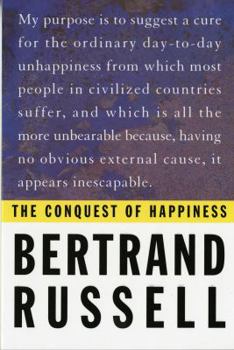
The Conquest of Happiness

Select Format
Select Condition 
Book Overview
In The Conquest of Happiness, first published by Liveright in 1930, iconoclastic philosopher Bertrand Russell attempted to diagnose the myriad causes of unhappiness in modern life and chart a path out... This description may be from another edition of this product.
Format:Paperback
Language:English
ISBN:0871401622
ISBN13:9780871401625
Release Date:March 1996
Publisher:Liveright
Length:192 Pages
Weight:0.76 lbs.
Dimensions:8.3" x 0.5" x 5.5"
Customer Reviews
5 ratings
just a few comments
Published by Thriftbooks.com User , 21 years ago
The other reviewers have done a fine job reviewing the book, and I'd just like to emphasize a few points. 1. Although a few of the references are dated because the book was written in 1930, all of the ideas are still perfectly relevant. 2. This is not a book of formal philosophy; more of introspection. Of course Russel introspected with the same brilliant and critical mind that he used to contribute to mathematics and philosophy. But this is not rigorous, apologetic or systematic. Actually, it's more like gentle advice. And quite reasonable. I'd like to quote a few passages that I found thought-provoking, to give a reader a sense of what to expect if you purchase and read this book: p. 27, "[T]o be without some of the things you want is an indispensable part of happiness." p. 29, "The habit of looking to the future and thinking that the whole meaning of the present lies in what it will bring forth is a pernicious one. There can be no value in the whole unless there is value in the parts." p. 43, "I do not deny that the feeling of success makes it easier to enjoy life.... Nor do I deny that money, up to a certain point, is very capable of increasing happiness. What I do maintain is that success can only be one ingredient in happiness, and is too dearly purchased if all the other ingredients have been sacrificed to obtain it." p. 74, "The essentials of human happiness are simple, so simple that sophisticated people cannot bring themselves to what it is that they really lack." p. 94, "[R]emember that your motives are not always as altruistic as they seem to yourself... don't overestimate your own merits... don't expect others to take as much interest in you as you do in yourself." p. 99, "No satisfaction based upon self-deception is solid, and however unpleasant the truth may be, it is better to face it once and for all, to get used to it, and to proceed to build your life in accordance with it." p. 107, "One should respect public opinion in so far as is necessary to avoid starvation and to keep out of prison, but anything that goes beyond this is voluntary submission to an unnecessary tyranny, and is likely to interfere with happiness in all kinds of ways." p. 109, "Happiness is promoted by associations of persons with similar tastes and similar opinions." p. 123, "The secret of happiness is this: let your interests be as wide as possible, and let your reactions to the things and persons that interest you be as far as possible friendly rather than hostile." p. 142, "In the best kind of affection a man hopes for a new happiness rather than for an escape from an old unhappiness." p. 175, "To ignore our opportunities for knowledge, imperfect as they are, is like going to the theater and and not listening to the play." Well, that's a reasonable sample. It's not a philosophical masterpiece, but it is mature, wise and edifying. I think most people who read books would do well to read this one too, so I give it a hearty endorsement.
A delightful, wise and thought-provoking read
Published by Thriftbooks.com User , 21 years ago
Iam in my late twenties and am of a somewhat introspective nature. I had struggled for a time to find what really made me happy and had come to the conclusion that it was taking interest in people and my work amongst other things. I started reading this book and was absolutely enthralled that someone had put into words so beautifully some of the thoughts I had been fumbling towards. I read the entire book in the first sitting. Read the book, it is filled with so much common-sense and rationality yet fills you with a lot of exhilaration and a feeling that life is very joyful after all. Or just read it for his language which is quite exquisite.
Good, Practical Advice
Published by Thriftbooks.com User , 22 years ago
I had been a long-time reader and admirer of Bertrand Russell but had not heard of this book until recently. Because I'd been going through some trying times personally, I ordered this book for its practical benefits, rather than as an exercise in philosophical discourse. I was not disappointed. This book was written over 70 years ago, but its message is profoundly relevant. In the entire book, there might have been three or four paragraphs that were outdated, such as Russell's stating that most women stay home while their husbands work. In 1930, that was indeed the case. But 99 percent of the book is right on target in the year 2004, for both men and women. I highly recommend this volume because of the benefits the reader will derive. As I mentioned, I myself had been suffering through an extremely difficult period. This book helped me considerably. I took a pen to highlight the most helpful parts of the book. It would have been more efficient for me to highlight the parts that were not helpful, since I ended up underlining most of the text. If you're considering psychotherapy to help you with an emotional problem or family crisis, save yourself a bundle of money -- and get better results -- reading this outstanding volume by one of the 20th century's most brilliant thinkers and writers. David Mills Author of 'Atheist Universe'
Book puts life in wonderful perspective.
Published by Thriftbooks.com User , 26 years ago
Russell makes a departure from philosophy with this work, which is really more akin to bibliotherapy. In various chapters, he discusses all kinds of things that make people both unhappy (e.g., competition, boredom, fatigue) and happy (e.g., affection, family, work). His focus is really on what we can do to be happy on a consistent basis; he's not looking for a temporary fix.Perhaps his 'philosophy of happiness' can best be summarized in this wonderful quote: 'Of all forms of caution, caution in love is perhaps most fatal to true happiness.' Succinct and true.
Hits the nail on the head
Published by Thriftbooks.com User , 27 years ago
In this book Bertrand Russell writes about things that cause unhappiness and--as the author himself explains--having no outside cause, are all the more distressing since they seem to have no solution. Russell proposes answers for the everyday happiness that every human being is bound to suffer. His chapters include Envy (the greatest of human passions, according to him), Persecution Mania (a VERY interesting chapter), Family, Work, and so on. A few things in the book must be taken with a grain of salt; however, I fell that on the whole Russell hits the nail on the head and offers us a work that is part philosophy, part psychology, and very effective in doing what it proposes. The second part of the book contains chapters that explain the cause of happiness, and how one can attain it. In the end, I put down the book knowing a bit more about human nature, and realizing that a book that was written so long ago is incredibly current--the truth that human nature never changes is one of the book's corollaries.
Copyright © 2026 Thriftbooks.com
Terms of Use | Privacy Policy | Do Not Sell/Share My Personal Information | Cookie Notice | Cookie Preferences | Accessibility Statement
ThriftBooks ® and the ThriftBooks ® logo are registered trademarks of Thrift Books Global, LLC
ThriftBooks ® and the ThriftBooks ® logo are registered trademarks of Thrift Books Global, LLC
