


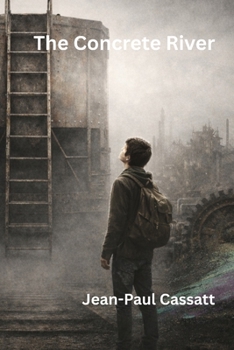
The Concrete River

"The river didn't take me to a new world. It just took me three miles downstream to a place where the air tasted like ozone and the men spoke in the dialect of a machine."
In the dying town of Vanceburg, Kentucky, where the prosperity of the Atlas Glass Works has been replaced by rusted corrugated metal and "For Sale" signs, seventeen-year-old Cassius Finn is a "glitch in the accounting." Raised by a ruffian father and left behind by a mother who chose her own survival, Cassius has learned the hard way that "civilization" is often just another word for a cage.
When his father's violence forces him to flee, Cassius hitches a ride on a spectral freight train, expecting to find freedom on the horizon. Instead, he falls into the "Invisible City"-a vast, subterranean world of industrial myth and philosophical surrealism hidden beneath the feet of the surface world.
Guided by a traveler named Linc and a twitchy courier named Silas, Cassius must navigate a landscape where the rules are absolute yet entirely absurd. From the Library of Dust, where forgotten memos settle like gold, to the Steam-Powered Court, where identity is treated as "Evidence," Cassius discovers that every system in the city-and the world above-is designed to turn the individual into a commodity.
Drawing on the classic river-bound wanderlust of Mark Twain, the surreal logic of Lewis Carroll, and the intellectual steel of Ayn Rand, The Concrete River is a bold hybrid of grit and philosophy. It is the story of a boy who refuses to be owned, a man who learns that his own rational judgment is the only territory that can never be truly conquered.
In a world that demands we all be part of the engine, the most radical thing you can be is the weather.
Customer Reviews
ThriftBooks ® and the ThriftBooks ® logo are registered trademarks of Thrift Books Global, LLC
