


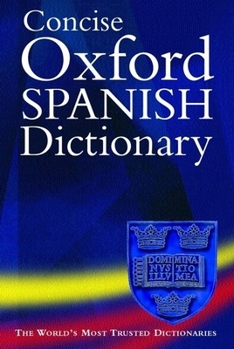
Concise Oxford Spanish Dictionary

Based on the acclaimed Oxford Spanish Dictionary, this new concise edition retains all the unique features of the parent volume. The result of over ten years' research, the dictionary has been compiled from a unique electronic database of current language, providing a truly fresh description of contemporary Spanish and English. With thousands of authentic example sentences carefully selected to illustrate the full range of meanings and contexts, this new version offers coverage of 24 varieties of Spanish as it is written and spoken throughout the Spanish-speaking world.
Features:
- Over 170,000 words and phrases, and over 240,000 translations
- Completely up-to-date coverage of contemporary Spanish and English, both written and spoken, including new expressions such as ethnic cleansing, glass ceiling, virtual reality, and serial killer
- Fuller coverage of Latin-American Spanish and American English than any dictionary of comparable size
- Thousands of example sentences carefully selected to illustrate the full range of meanings and typical contexts
- Full and clear guidance on key constructions, complementation, and difficult points of grammar
- Guide to personal and business correspondence, including job applications, business faxes, making reservations, and making complaints
- Full verb tables
{Spanish language jacket info tc}
Features:
- Over 170,000 words and phrases, and over 240,000 translations
- Completely up-to-date coverage of contemporary Spanish and English, both written and spoken, including new expressions such as ethnic cleansing, glass ceiling, virtual reality, and serial killer
- Fuller coverage of Latin-American Spanish and American English than any dictionary of comparable size
- Thousands of example sentences carefully selected to illustrate the full range of meanings and typical contexts
- Full and clear guidance on key constructions, complementation, and difficult points of grammar
- Guide to personal and business correspondence, including job applications, business faxes, making reservations, and making complaints
- Full verb tables
{Spanish language jacket info tc}
Format:Paperback
Language:English
ISBN:0198602448
ISBN13:9780198602446
Release Date:May 2003
Publisher:Oxford University Press
Length:1502 Pages
Weight:3.95 lbs.
Dimensions:6.4" x 2.7" x 9.5"
Customer Reviews
1 rating
One of the best available
Published by Thriftbooks.com User , 19 years ago
My Master's thesis was a review and rating of large Spanish-English dictionaries. Though the title says "concise," this work at 1500 pages falls under the category of large. I find it, like all the other Oxford dictionaries, to be a good choice. Here are a few of the factors which distinguish a good bilingual dictionary from a bad one. To begin with, ignore certain publishers' marketing ploys such as entry and translation counts. They say nothing about the value of the words chosen. The first valid factor to consider is lexicographic technique. A bad dictionary simply lists translations. Take, for example, the entry in the Cassell's Spanish Dictionary under the English headword loop: "lazo, gaza, nudo; ojal, presilla, alamar; anillo; recodo, comba, curva, vuelta," etc. For the English reader writing in Spanish, this is hopelessly inadequate, as the dictionary provides no clue as to which translation to use in which situation. Compare the treatment of the same word in the far superior American Heritage Spanish Dictionary. "(length of line) lazo; (coil) vuelta; (bend) curva; (circular path) vuelta, circuito; (fastener) presilla" etc. Here, the user is given glosses in the native language to assist in identifying the right word for the context. Example sentences are also a tremendous help. Oxford is excellent in this respect, presenting good information to guide users through the semantic and syntactic complexities of translation. Second, a good dictionary should maintain an up-to-date lexicon, including such cultural and technological additions to the language as "baby sitter," "hostile takeover," "software," "flash drive." Oxford is a leader in this respect; its frequent revisions are more than mere window dressing and do a creditable job of covering the most recent additions to the language. Third, idioms, slang, and cusswords can present real problems to the language learner, and a dictionary needs to handle them in a clear and frank fashion. This dictionary gets it right, giving stylistic equivalents for translations as well as clear advice to the user. The Oxford Concise has a practical "language in use" section, which gives sample formats for correspondence as well as functions such as introduction, exposition, agreement, and disagreement. Be careful when you choose a bilingual dictionary, as some of the choices--Cassell's and Vox, for example--are downright terrible. The field of large dictionaries stays relatively static over time, and the best choices in it by far are Oxford, Collins, and Larousse.
Copyright © 2026 Thriftbooks.com
Terms of Use | Privacy Policy | Do Not Sell/Share My Personal Information | Cookie Policy | Cookie Preferences | Accessibility Statement
ThriftBooks ® and the ThriftBooks ® logo are registered trademarks of Thrift Books Global, LLC
ThriftBooks ® and the ThriftBooks ® logo are registered trademarks of Thrift Books Global, LLC
